


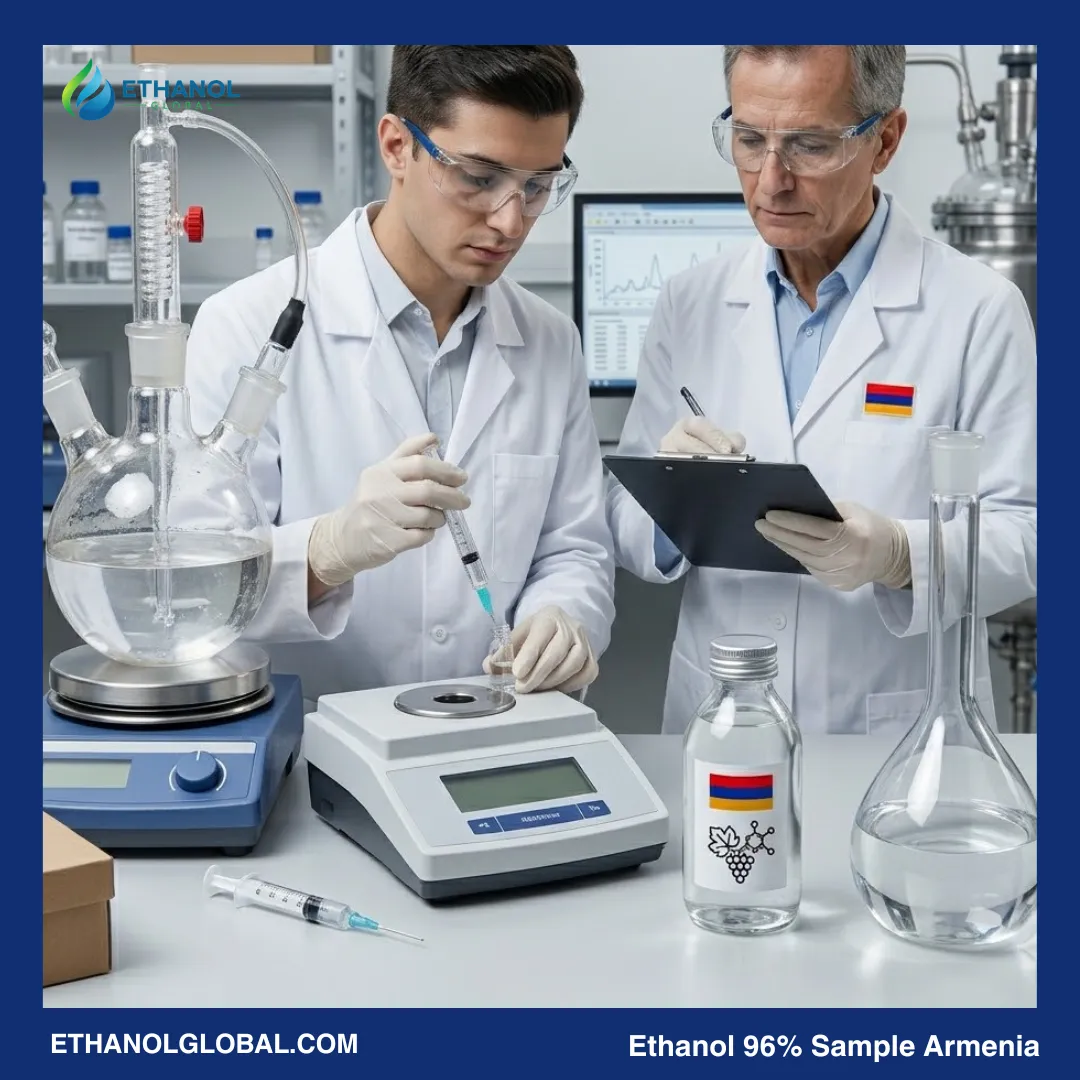
For Armenian manufacturers, purchasing industrial ethanol is a strategic procurement decision that directly affects production quality, regulatory compliance, and operating costs. Before committing to a full container or tanker shipment, requesting an Ethanol 96% Sample Armenia is one of the most effective ways to verify product quality and supplier credibility.
A properly evaluated sample helps manufacturers confirm whether the ethanol meets technical specifications, remains consistent between batches, and is suitable for their manufacturing processes. This article explains how Armenian buyers can request commercial ethanol samples, what laboratory tests should be performed, and how to make informed purchasing decisions.
Why Request an Ethanol 96% Sample Before Bulk Purchasing?
Industrial ethanol is widely used across Armenia in sectors including:
- Chemical manufacturing
- Pharmaceutical production
- Paints and coatings
- Cosmetics
- Cleaning chemicals
- Laboratory applications
- Printing inks
Even when suppliers advertise identical purity levels, product consistency, impurities, documentation, and manufacturing standards may differ.
Requesting an Ethanol 96% Sample Armenia allows buyers to:
- Verify product quality before placing large orders.
- Confirm compatibility with manufacturing equipment.
- Evaluate product performance.
- Review supplier documentation.
- Reduce procurement risks.
- Compare multiple suppliers objectively.
Sampling is significantly less expensive than dealing with quality issues after receiving an entire shipment.
Information to Include When Requesting a Sample
Providing clear technical requirements helps suppliers prepare an appropriate sample.
Your request should typically include:
- Required ethanol concentration (96%)
- Intended industrial application
- Required packaging type
- Estimated annual purchase volume
- Required delivery location in Armenia
- Need for laboratory documents
- Required regulatory certifications
Professional suppliers usually provide samples together with technical documentation for the same production batch.
Documents That Should Accompany the Sample
The sample itself is only part of the evaluation process.
Request the following documentation:
Certificate of Analysis (COA)
The COA verifies:
- Ethanol concentration
- Water content
- Density
- Appearance
- Typical impurity values
- Batch number
Safety Data Sheet (SDS)
The SDS explains:
- Safe handling
- Storage requirements
- Transportation classification
- Fire hazards
- Emergency procedures
Technical Data Sheet (TDS)
A TDS summarizes:
- Physical properties
- Chemical specifications
- Recommended industrial applications
Together, these documents help purchasing managers validate both product quality and supplier transparency.
Visual Inspection of the Sample
Before laboratory testing, perform a simple visual inspection.
Commercial Ethanol 96% should generally be:
- Clear and colorless
- Free from suspended particles
- Free from sediment
- Without cloudiness
- Packaged in clean, sealed containers
Packaging integrity is also important because ethanol readily absorbs moisture if exposed to air.
Essential Laboratory Tests
Manufacturers should not rely solely on supplier documentation.
Independent laboratory testing provides additional confidence and should be performed according to recognized ASTM test methods for ethanol quality assessment.
Recommended analyses include:
1. Ethanol Purity
Confirm the ethanol concentration matches the supplier specification.
2. Water Content
Water content affects numerous industrial processes, particularly solvent-based production.
3. Density
Density measurements help verify concentration and product consistency.
4. Appearance
Inspect for:
- Clarity
- Color
- Contamination
5. Impurity Analysis
Depending on the application, laboratories may test for:
- Methanol
- Higher alcohols
- Aldehydes
- Residue after evaporation
- Heavy metals (where applicable)
These tests ensure the product satisfies internal quality standards.
Evaluate Batch Consistency
Receiving one high-quality sample is only the first step.
Ask suppliers:
- Is every shipment produced under identical specifications?
- Is every batch individually tested?
- Will every shipment include its own COA?
- How are batches identified?
Reliable exporters perform batch-level sampling and maintain traceability throughout production and shipping.
Check Packaging Options
Manufacturers should also evaluate available packaging formats.
Common options include:
- 25 L drums
- 200 L steel drums
- IBC tanks
- ISO tank containers
- Bulk tanker deliveries
Packaging should match:
- Consumption rate
- Warehouse capacity
- Transportation requirements
- Safety regulations
Verify Storage Recommendations
A quality sample should include storage guidance.
Recommended practices generally include:
- Store in tightly sealed containers.
- Keep away from ignition sources.
- Avoid prolonged exposure to sunlight.
- Maintain proper warehouse ventilation.
- Prevent unnecessary exposure to moisture.
Proper storage preserves ethanol quality until production use.
Ask About Quality Assurance Procedures
Before selecting a supplier, discuss their quality management system.
Important questions include:
- How frequently is each batch tested?
- Which laboratory performs testing?
- Are samples retained for traceability?
- Are products manufactured under documented quality procedures?
- What happens if specifications are not met?
Suppliers with documented quality systems generally provide more reliable long-term performance.
Compare Multiple Suppliers
Rather than evaluating a single supplier, compare several Ethanol 96% Sample Armenia offers using standardized criteria.
Create a comparison table covering:
| Evaluation Factor | Supplier A | Supplier B |
|---|---|---|
| Purity | ✔ | ✔ |
| COA Availability | ✔ | ✔ |
| Packaging Options | ✔ | ✔ |
| Technical Support | ✔ | ✔ |
| Delivery Time | ✔ | ✔ |
| Batch Traceability | ✔ | ✔ |
This structured approach simplifies supplier selection.
Common Mistakes When Testing Ethanol Samples
Avoid these frequent procurement errors:
- Selecting suppliers based only on price.
- Ignoring laboratory documentation.
- Skipping independent testing.
- Failing to verify batch consistency.
- Overlooking packaging suitability.
- Not reviewing safety documentation.
- Ordering bulk quantities without sample approval.
Each of these mistakes can increase operational costs later.
Best Practices for Sample Handling
To ensure accurate laboratory results:
- Keep samples sealed until testing.
- Use clean containers if transferring the liquid.
- Avoid contamination.
- Label every sample clearly.
- Record batch numbers.
- Store samples according to supplier recommendations.
Representative sampling and proper handling are essential to obtaining reliable analytical results.
Conclusion
Requesting an Ethanol 96% Sample Armenia is a practical step that helps manufacturers minimize procurement risks before committing to bulk purchases. By reviewing technical documentation, conducting independent laboratory testing, verifying batch consistency, and comparing multiple suppliers, Armenian manufacturers can build a more reliable and cost-effective ethanol supply chain.
Companies seeking consistent Ethanol 96% Sample Armenia solutions should work with suppliers that provide complete documentation, batch traceability, and transparent quality assurance to support long-term industrial partnerships.
As a trusted supplier and exporter of high-quality Ethanol 96%, we provide reliable sourcing, comprehensive quality documentation, and dependable international logistics to support manufacturers across Armenia and global markets.