




Why many ethanol quotes get delayed
Most ethanol quotation delays happen for one simple reason: the request is missing the variables that define the real delivered cost. When a supplier must guess your grade, packaging, Incoterms, destination, and documentation scope, they either delay the quotation or send a “rough number” that is not reliable. That creates extra back-and-forth, and in fast-moving logistics conditions, even a few days of delay can change freight availability, lead time, and final landed cost.
A complete RFQ (request for quotation) helps both sides. Buyers get a quotation they can actually compare and approve internally. Suppliers can price accurately, reserve the right packaging, and plan export documentation correctly. If you want to know how to request an ethanol quotation in a way that produces a usable offer, the checklist below is the fastest method.
What to do before you request a quote
Before sending an RFQ, align internally on three points:
– End-use: fuel blending, industrial solvent, pharma/technical use, or general industrial use
– Delivery basis: do you want the seller to handle logistics (CFR/CIF) or will you manage freight (FOB/FCA/EXW)?
– Packaging reality: what your destination can receive and store safely (bulk, IBC, drums)
This internal alignment avoids re-quoting later.
The quotation checklist buyers should send
A strong ethanol RFQ contains six blocks of information. If you copy/paste this structure into an email, most suppliers can quote faster and with fewer follow-up questions.
Product and specification
Provide the product definition first, not last.
– Grade (example: ethanol 96% v/v)
– Intended use (fuel blending, industrial solvent, cleaning, etc.)
– Required limits (water, acidity, impurities—only if you have specific limits)
Mention if you need denatured or undenatured ethanol (where applicable)
Quantity and shipment plan
-Total volume (and unit: MT, liters, drums count, IBC count)
– Shipment frequency (one-time / monthly / quarterly)
– Target loading date window (example: “within 10–14 days after dow`n payment”)
Packaging preference
Your packaging decision affects price, safety, and moisture risk.
– Preferred packaging: tanker / IBC / drums
– Material/lining requirements if you have them
– Label requirements (language, HS code, hazard labeling format)
Destination and Incoterms
This is the biggest cause of misunderstanding in quotations.
Destination city/port (and final delivery point if needed)
Incoterm preference: EXW, FCA, FOB, CFR, CIF, etc.
Preferred route or any restricted routes
Preferred freight method (sea/road/rail) and whether you want the seller to quote freight or you will nominate a forwarder
Tip: If you ask for “best price” without Incoterms, you may receive a price that cannot be compared to other offers.
Documentation requirements
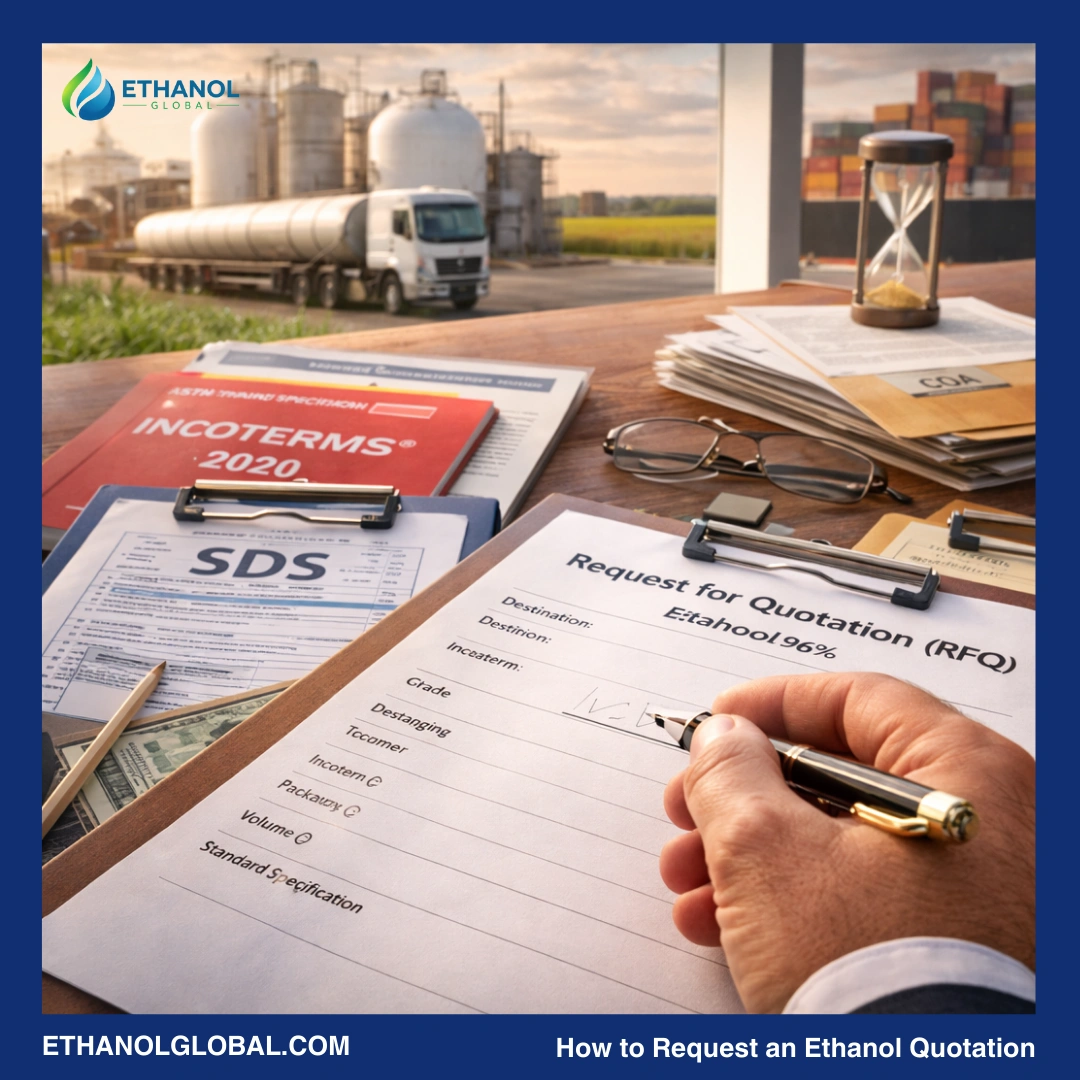
B2B ethanol trade is document-heavy. Mention your required set upfront.
– COA (batch-specific)
– SDS/MSDS
– Export documents requested by your broker (invoice, packing list, bill of lading/CMR, etc.)
– Any inspection needs (third-party inspection, loading supervision, etc.)
Tip: If your customs broker expects a specific COA format or language, share that requirement early.
Commercial terms and compliance
-Payment preference (TT, LC, split payments, etc. — only what you actually use)
-Required quotation validity (example: “valid for 5 business days”)
-Any compliance requirements (restricted end-use clauses, destination restrictions, etc. if relevant)
What a good supplier quotation should include
A buyer-friendly quotation is not only a number. It should be usable for internal approval and contract drafting. A strong offer includes:
– Unit price and unit basis (USD/MT, USD/L, etc.)
– Incoterms clearly stated + named place/port
– Product grade/spec and reference to COA/spec sheet
– Packaging details (type, count, net weight, gross weight)
– Lead time (production/availability + loading time)
– Quotation validity (how long the price is valid)
– Documentation list included in the offer
– Payment terms and banking details (if applicable)
– Any inclusions/exclusions (port charges, local delivery, inspection fees, demurrage responsibility)
Tip: If any of these items are missing, you may not be comparing like-for-like across suppliers.
Common mistakes that create bad comparisons
Avoid these typical procurement errors:
– Comparing EXW with CFR and thinking it’s “price movement”
– Ignoring packaging differences (drums vs IBC vs ISO tank)
– Not clarifying whether documents like COA and COO are included
– Asking for “best price” without destination and Incoterms
– Approving a quote without checking lead time and validity
Ethanol Global approach
At Ethanol Global, we prefer quotation requests that are clear and comparable. Share your destination, volume, packaging preference, and intended use, and we respond with:
a clear quotation basis (unit + Incoterms + named destination)
realistic lead time and shipment window
packaging and logistics options suited to your route
an export documentation set aligned with trade workflows