
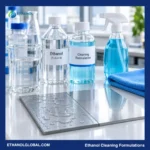

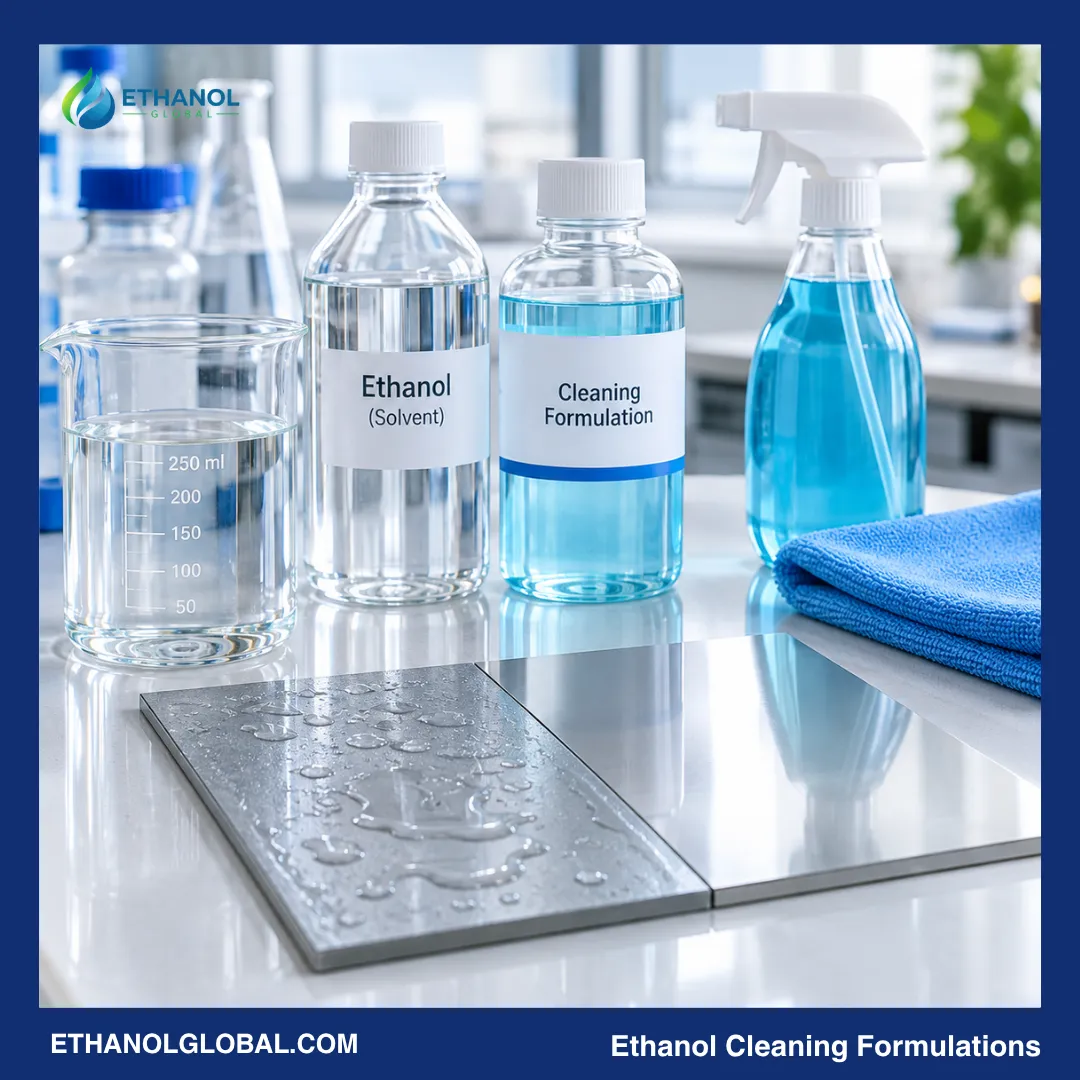
Ethanol is widely used in industrial and commercial cleaning products because it dissolves many organic contaminants and evaporates relatively quickly. However, effective cleaning depends on more than simply adding ethanol to a formulation. Ethanol cleaning formulations must achieve the right balance between solvent strength, evaporation rate, water content and other ingredients to deliver consistent surface performance.
When the solvent balance is properly controlled, ethanol-based cleaners can remove oils, residues and fingerprints while leaving surfaces relatively clean and dry. On the other hand, an unsuitable formulation may evaporate too quickly, leave streaks or fail to dissolve certain contaminants effectively.
Why Ethanol Is Used in Cleaning Formulations
Ethanol has several properties that make it useful for cleaning applications. It can dissolve a wide range of organic substances, including oils, greases and some residues. Its volatility also allows cleaned surfaces to dry relatively quickly. The chemical properties and solvent behavior of ethanol are documented in scientific databases such as PubChem.
In addition, ethanol can be incorporated into water-based formulations to modify evaporation and solvency. This flexibility makes it suitable for different cleaning products, including surface cleaners, industrial maintenance products and specialized formulations.
However, ethanol concentration alone does not determine cleaning performance. The interaction between ethanol, water and other formulation components can significantly affect the final product.
Understanding Solvent Balance
Solvent balance refers to how different solvents and formulation ingredients work together to provide the desired cleaning properties. In an ethanol-based cleaner, the balance between ethanol and water is particularly important.
A higher ethanol concentration can increase solvent strength for certain organic contaminants and may accelerate evaporation. However, very rapid evaporation can reduce the contact time available for dissolving stubborn residues.
Water, meanwhile, can slow evaporation and improve the removal of some water-soluble contaminants. Therefore, formulators often adjust the ethanol-to-water ratio according to the target surface and type of contamination.
The ideal balance depends on the intended application rather than a single universal ethanol concentration.
How Ethanol Concentration Affects Drying
Drying speed is one of the most noticeable characteristics of ethanol-based cleaners. Because ethanol is volatile, formulations containing ethanol can dry faster than many purely water-based cleaning products.
Fast drying can be beneficial when surfaces need to return to service quickly. It can also reduce the amount of liquid remaining on surfaces after cleaning.
However, extremely fast evaporation may create formulation challenges. If the cleaner disappears before contaminants are sufficiently dissolved, cleaning efficiency can decrease. Therefore, the fastest-drying formulation is not necessarily the most effective one.
A controlled evaporation rate can provide enough contact time for soil removal while still allowing the surface to dry efficiently.
Surface Performance and Residue Control
Surface appearance is another important consideration when developing ethanol cleaning formulations. A cleaner should remove contaminants without leaving excessive residues, streaks or visible marks.
The presence of water, surfactants, fragrances and other additives can influence the final surface appearance. For example, some additives may improve cleaning performance but leave residues if they are not properly balanced. Ethanol-based disinfectant and cleaning applications also demonstrate how solvent selection can influence drying behavior, residue control, and overall surface performance.
For this reason, formulation testing should evaluate both cleaning efficiency and the appearance of the treated surface after drying.
The Role of Water in Ethanol-Based Cleaners
Water is not simply a diluent in ethanol formulations. It can influence solvency, evaporation rate and compatibility with different contaminants.
Increasing the water content can slow drying and may improve the removal of certain polar contaminants. However, excessive water can reduce the ability of the formulation to dissolve some oily or hydrophobic substances.
Consequently, formulators need to consider the chemical characteristics of the contaminants as well as the surface being cleaned.
Choosing the Right Formulation for Different Surfaces
Different surfaces require different cleaning characteristics. Glass, stainless steel, plastics, painted surfaces and electronic components may respond differently to the same ethanol formulation.
For example, a formulation designed for fast cleaning of glass may prioritize rapid evaporation and low residue. An industrial cleaner for oily equipment may require stronger solvency and sufficient contact time.
Surface compatibility should also be evaluated before commercial use. Certain plastics, coatings, adhesives and finishes can be sensitive to solvents, so compatibility testing is an important part of product development.
Ethanol and Organic Contaminants
One of the main advantages of ethanol is its ability to interact with many organic contaminants. This makes it useful for removing fingerprints, light oils and other residues from suitable surfaces.
Nevertheless, ethanol is not equally effective against every type of contamination. Heavy grease, polymerized residues or highly specialized industrial soils may require additional solvents, surfactants or mechanical cleaning.
Therefore, ethanol should be selected based on the complete contamination profile rather than used as a universal cleaning solvent.
Formulation Factors That Influence Cleaning Efficiency
Several factors can affect the performance of an ethanol-based cleaner:
- Ethanol concentration: Influences solvency and evaporation characteristics.
- Water content: Affects drying speed and compatibility with polar contaminants.
- Surfactants: Can improve wetting and help remove certain soils.
- Additives: May modify stability, fragrance, surface appearance or other properties.
- Contact time: Determines how long the formulation can interact with contaminants.
- Surface type: Influences solvent compatibility and the required cleaning strength.
These factors should be evaluated together because changing one component can affect the performance of the entire formulation.
Balancing Cleaning Power and Drying Speed
A successful ethanol-based formulation must balance cleaning power with drying behavior. Increasing solvent strength may improve the removal of certain contaminants, but excessive volatility can shorten contact time.
Conversely, slowing evaporation may provide more time for soil dissolution but can increase drying time and potentially affect the user experience.
The objective is therefore not simply to maximize ethanol concentration. Instead, formulation development should focus on achieving the desired combination of solvency, evaporation, surface compatibility and residue control.
Testing Ethanol Cleaning Formulations
Performance testing helps determine whether a formulation meets its intended requirements. Testing can include soil removal, drying time, streak formation, residue assessment and surface compatibility.
For industrial applications, testing should ideally use representative contaminants and actual substrate materials. This approach provides more useful information than evaluating the cleaner only under ideal laboratory conditions.
Repeatability is also important. A formulation should deliver consistent results across multiple tests and production batches.
Industrial Applications of Ethanol-Based Cleaners
Ethanol-based cleaning products can be used across a range of applications where solvent-based cleaning and relatively rapid drying are desirable.
Potential applications include:
- General industrial surface cleaning
- Removal of fingerprints and light oils
- Equipment maintenance
- Glass and hard-surface cleaning
- Cleaning before certain manufacturing processes
- Specialized commercial cleaning products
The appropriate ethanol concentration and supporting ingredients depend on the requirements of each application.
Conclusion
Ethanol cleaning formulations rely on careful solvent balance rather than ethanol concentration alone. The relationship between ethanol, water and other formulation components influences cleaning strength, evaporation rate, contact time, residue formation and surface compatibility.
By optimizing these factors for the intended contaminant and substrate, formulators can develop cleaning products that provide effective soil removal while maintaining suitable drying and surface performance. For industrial and commercial applications, controlled formulation and practical performance testing remain essential for achieving consistent results.
As a trusted ethanol producer and exporter, Ethanol Global supplies high-quality ethanol for industrial, cleaning, pharmaceutical, and other applications, with reliable quality and export solutions tailored to global buyers.