



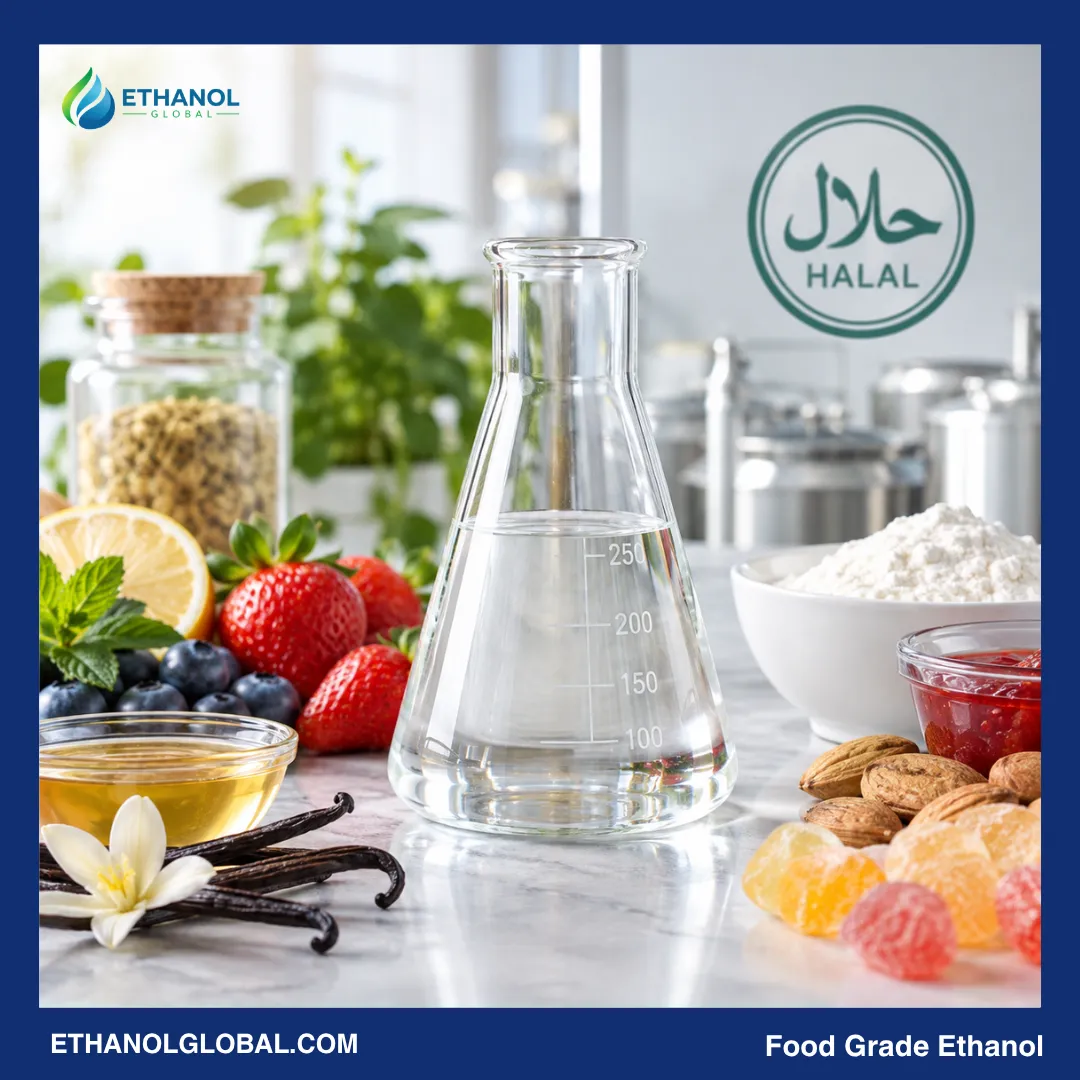
Food grade ethanol plays an important role in modern food manufacturing, particularly in flavor extraction, food flavoring, ingredient processing, and the production of certain food additives. Unlike ethanol intended for alcoholic beverages, food grade ethanol used in food processing must meet appropriate quality, purity, safety, and regulatory requirements.
For manufacturers serving Muslim markets, another important consideration is halal certification. The halal status of ethanol depends on factors such as its source, intended use, production process, concentration, and the requirements of the relevant certification authority. Therefore, food manufacturers and exporters should evaluate both the technical specifications of ethanol and the halal requirements of their target market.
What Is Food Grade Ethanol?
Food grade ethanol is ethanol that meets quality requirements suitable for specific applications in food production. It can function as a solvent, extraction medium, processing aid, or carrier for certain food ingredients and flavors.
Its suitability for food applications depends on more than ethanol concentration alone. Manufacturers should consider purity, contaminants, production method, denaturing status, documentation, and compliance with applicable food regulations.
Food grade ethanol should also be clearly distinguished from industrial or denatured ethanol. Denatured ethanol may contain substances that make it unsuitable for direct food applications. Therefore, food manufacturers should obtain technical specifications and certificates from qualified suppliers before using ethanol in a food production process.
Applications of Food Grade Ethanol in the Food Industry
Ethanol suitable for food applications has several practical uses across food processing and ingredient manufacturing.. For a broader overview of ethanol applications in food processing, see our guide to food-related applications of ethanol.
1. Flavor and Aroma Extraction
One of the most important applications of food grade ethanol is the extraction of flavor and aroma compounds from natural materials.
Ethanol can dissolve many organic compounds that are difficult to extract efficiently with water alone. This makes it useful for producing extracts from herbs, spices, fruits, botanicals, and other flavoring materials.
After extraction, manufacturers can process the extract to reduce the ethanol concentration or remove most of the solvent, depending on the formulation and applicable regulations.
2. Food Flavoring
Ethanol can act as a carrier or solvent for certain food flavors. Some flavor compounds have limited solubility in water, while ethanol can help distribute them more effectively within a formulation. The FAO/WHO JECFA specifications for flavouring ethanol provide internationally recognized technical information for this application.
This application is particularly relevant to liquid flavor systems and concentrated flavor preparations.
However, the use of ethanol in flavoring does not automatically make a finished product non-halal. The source, purpose, concentration, and final residual level must be evaluated according to the applicable halal standard and certification body. For example, MUIS states that certain ethanol used as a solvent in food flavoring can be permissible when it is not produced from prohibited sources and remains within specified limits.
3. Extraction of Natural Ingredients
Food grade ethanol is also used to extract compounds from plant-based raw materials.
Depending on the production method, ethanol extraction can help manufacturers obtain:
- Natural flavor compounds
- Aromatic compounds
- Botanical extracts
- Certain functional ingredients
- Compounds used in food supplements and specialty food formulations
The extraction process can be adjusted according to the chemical characteristics of the target compounds.
4. Production of Food Ingredients
Some food ingredients and specialty preparations require ethanol during manufacturing. In these processes, ethanol can function as a solvent or processing medium rather than as a final ingredient.
The manufacturer must control the process carefully so that the final product complies with applicable food safety and halal requirements.
5. Food Processing and Processing Aids
Ethanol can be used as a processing aid in specific food manufacturing applications. Its role may include facilitating extraction, dissolving ingredients, or supporting the production of certain formulations.
When ethanol is used as a processing aid, manufacturers should document where it enters the production process, how it is handled, and how much remains in the finished product.
Is Food Grade Ethanol Halal?
The halal status of ethanol is more complex than simply determining whether a product contains alcohol.
Different halal authorities can apply different criteria concerning the source of ethanol, its intended use, concentration, and residual level. Research comparing halal standards in Southeast Asia has identified differences between authorities in countries such as Malaysia, Indonesia, Brunei, and Singapore.
Therefore, manufacturers should not assume that one ethanol limit automatically applies to every export market.
A key distinction is between ethanol intentionally produced for alcoholic beverages and ethanol used for legitimate industrial or food-processing purposes. Some halal authorities allow certain applications of ethanol when the material does not originate from prohibited sources and its use meets the applicable halal requirements.
Key Halal Certification Requirements for Food Grade Ethanol
Companies seeking halal certification should evaluate several aspects of their ethanol supply chain.
1. Ethanol Source
The source of ethanol is an important consideration during halal assessment.
Manufacturers should be able to provide information about how the ethanol was produced and the raw materials used in its production. Ethanol associated with prohibited alcoholic beverages can receive different treatment from ethanol intended for technical, food-processing, or other industrial applications.
For this reason, supplier documentation and traceability are essential.
2. Intended Use
The purpose for which ethanol is used can influence its halal assessment.
Ethanol used as a solvent or carrier in food flavoring may be assessed differently from ethanol intentionally used to manufacture an alcoholic beverage.
The intended application should therefore be clearly documented in the product specification and halal certification process.
3. Ethanol Concentration and Residual Level
Halal authorities may establish limits for ethanol in food products, ingredients, flavorings, or beverages.
For example, GSO 2538 addresses maximum limits for ethyl alcohol residues in food, while other halal systems establish their own requirements.
Because these limits can vary, exporters should identify the exact standard required in the destination market instead of relying on a universal threshold.
4. Production and Processing Controls
Halal certification can involve more than testing the final ethanol concentration.
Auditors may evaluate raw materials, production processes, storage, handling, cleaning procedures, and the possibility of cross-contamination with non-halal materials.
A documented halal assurance system can therefore help manufacturers demonstrate consistent compliance throughout the production chain.
5. Supplier Documentation
Food manufacturers should request appropriate documentation from ethanol suppliers.
Depending on the market and certification program, relevant documents may include:
- Certificate of Analysis (COA)
- Safety Data Sheet (SDS)
- Product specification
- Origin information
- Production-process information
- Halal certificate, where applicable
- Batch or lot traceability documents
Complete documentation can simplify supplier approval and halal audits.
Testing Ethanol in Food Products
Laboratory testing can help verify ethanol concentrations in food and beverage products.
Validated analytical methods such as gas chromatography with flame ionization detection (GC-FID) can be used to determine ethanol concentrations in different food matrices. Research has demonstrated the suitability of validated GC-FID methods for routine ethanol analysis and halal verification.
Testing is particularly useful when a manufacturer needs to demonstrate compliance with a specific maximum residue limit.
However, laboratory testing should complement rather than replace proper source control, documentation, and halal assurance procedures.
Why Halal Requirements Differ Between Markets
One of the main challenges for international food manufacturers is that halal requirements are not completely uniform worldwide.
Different certification bodies may use different criteria for:
- Ethanol source
- Ethanol concentration
- Residual ethanol in finished products
- Flavoring applications
- Processing aids
- Analytical methods
- Production and handling controls
For example, published comparisons show differences between halal standards regarding intentionally added non-khamr ethanol, naturally occurring ethanol, and ethanol in flavorings.
As a result, exporters should identify the requirements of the target certification body before finalizing an ethanol-containing formulation.
How Food Manufacturers Can Prepare for Halal Certification
A structured approach can reduce compliance risks and simplify certification.
Step 1: Identify Every Ethanol Source
Review all raw materials, flavors, extracts, additives, and processing aids that may contain ethanol.
Step 2: Verify Supplier Information
Request technical specifications, certificates, origin information, and halal documentation where available.
Step 3: Determine the Intended Function
Document whether ethanol functions as a solvent, extraction medium, carrier, processing aid, or another component.
Step 4: Evaluate the Final Product
Determine the expected ethanol residue in the finished product and compare it with the requirements of the destination market.
Step 5: Select the Appropriate Halal Standard
Work with the halal certification body relevant to the target country or market.
Step 6: Maintain Traceability
Keep records that allow each ethanol-containing raw material to be traced from supplier to finished product.
Step 7: Conduct Laboratory Verification When Required
If the certification program requires ethanol analysis, use an appropriate validated analytical method and maintain the test records.
Food Grade Ethanol for International Food Markets
For exporters, food grade ethanol is not simply a chemical raw material. Its source, purity, documentation, application, and regulatory status can directly affect whether a food ingredient or finished product can enter a specific market.
This is especially important when supplying food manufacturers in regions where halal certification is commercially important.
A reliable ethanol supplier should therefore provide consistent product specifications and appropriate documentation while supporting customers with information about purity, origin, packaging, and intended applications.
Conclusion
Food grade ethanol has several valuable applications in the food industry, particularly in flavor extraction, natural ingredient extraction, flavoring systems, and specialized food processing. Its role as a solvent and carrier makes it useful for manufacturing a wide range of food ingredients and formulations.
At the same time, halal certification requires careful evaluation of ethanol source, intended use, concentration, production process, and residual levels. There is no single universal ethanol limit that applies to every halal market, so manufacturers and exporters should follow the requirements of the relevant certification authority.
By combining suitable food grade ethanol, reliable supplier documentation, traceability, process controls, and appropriate laboratory testing, food manufacturers can better manage halal compliance and support access to international halal markets.
For reliable sourcing of high-quality Food Grade Ethanol, choose Ethanol Global as your trusted supplier and export partner. We provide consistent-quality ethanol for food and industrial applications, with professional support for international orders, documentation, and global delivery.