





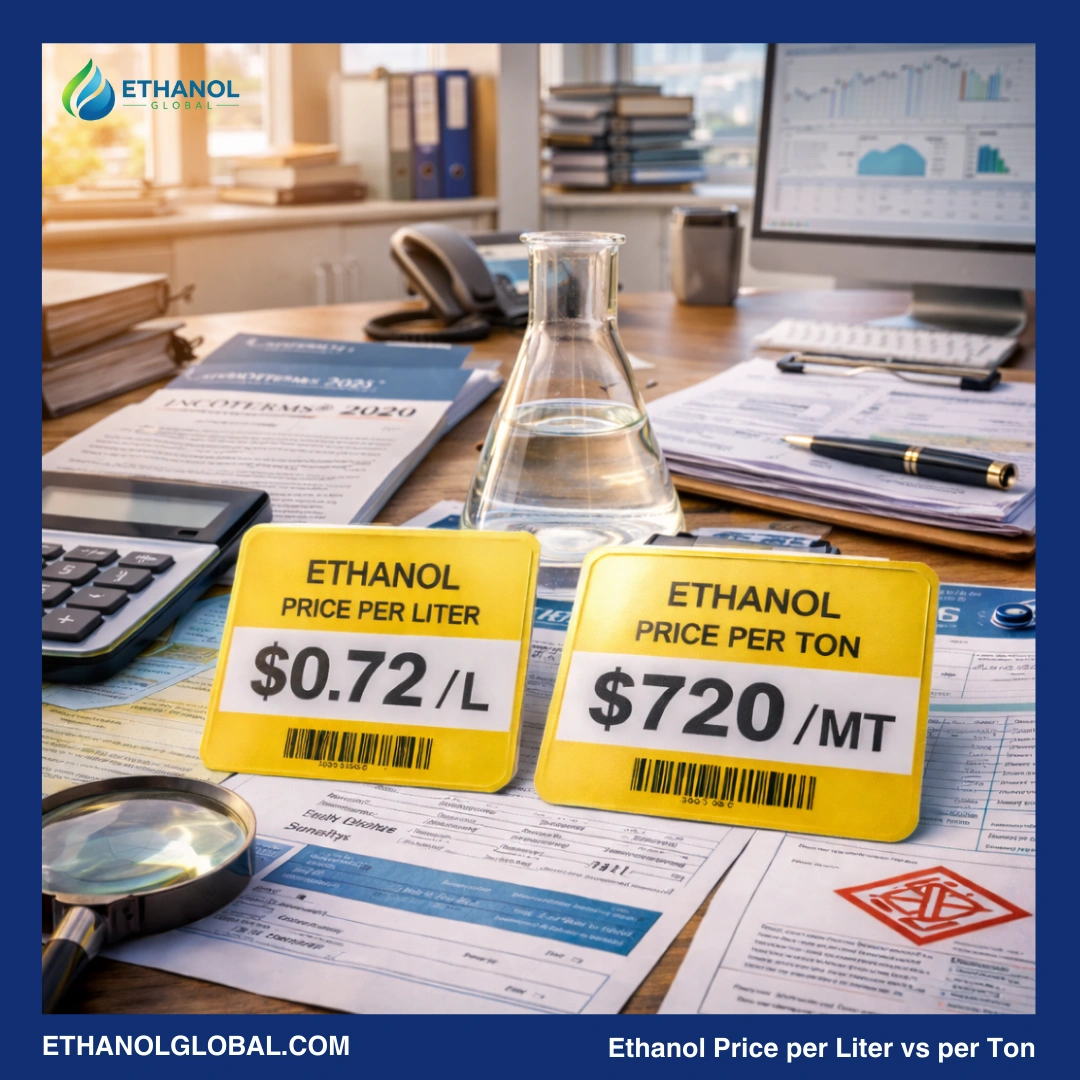
When you request offers in international trade, you may receive ethanol prices quoted in different units: some suppliers quote USD per liter, while others quote USD per metric ton (MT). This is normal, but it can confuse buyers and lead to wrong comparisons—especially when the quotations are based on different packaging, different Incoterms, or different product grades. If you want to compare suppliers fairly and avoid hidden cost surprises, you need a simple procurement method.
Why quotes come in different units
Suppliers often quote per liter when the buyer is used to volume-based purchasing or when the shipment is packaged (drums or IBC). Many exporters and commodity traders quote per metric ton because bulk shipments, freight calculations, and trade documents often use weight. Neither approach is “more correct,” but mixing units without a conversion method can make one supplier look cheaper when it is not.
The key: conversion depends on density
To convert liter ↔ ton, you need the density of the ethanol grade being sold. Density can vary with concentration (for example ethanol 96% v/v vs other grades), temperature, and specification window. A responsible quotation should clearly state:
– the grade/spec (example: ethanol 96% v/v)
– a density reference (typical range or stated value)
– the temperature basis, if relevant for precise conversion
In practical procurement, you can ask the supplier to confirm the density used in their quote and to provide both units (USD/L and USD/MT) on the same Incoterm. That removes confusion during internal approval.
What else changes the “real” price
Packaging
Packaging has a direct impact on unit cost and risk:
– Drums usually cost more per unit due to filling, handling, and loading labor.
– IBC is often mid-range, offering a balance of efficiency and flexibility.
– Tanker can be the most economical for bulk volume, but the best option depends on route, availability, cleaning/return conditions, and your receiving infrastructure.
Packaging is also a quality-control factor for ethanol because handling discipline and moisture protection matter in many supply chains.
Incoterms and delivery scope
A price is meaningless without delivery scope. Your landed cost changes significantly under:
– EXW / FCA: buyer handles most logistics
– FOB: seller delivers to export port, buyer handles ocean freight
– CFR/CIF: seller includes freight (and sometimes insurance) to destination
Always compare quotations on the same Incoterm + named place
Documentation and compliance
Depending on destination, extra costs can arise from:
– additional lab testing or inspection
– certificates required by customs
– special labeling or documentation formats
These should be clarified upfront to avoid surprise fees and delays.
A buyer-friendly comparison method
To compare offers fairly, standardize everything:
– convert to the same unit (commonly USD/MT delivered)
– use the same Incoterm and destination
– keep packaging type identical
– ensure the same spec and documentation set
Ethanol Global quotation clarity
Ethanol Global can quote in the unit you prefer and provide a conversion-friendly offer with clear packaging options, Incoterms, and a defined documentation scope—so your procurement team can compare offers accurately and approve faster.