



Introduction
The aviation industry is exploring new ways to reduce greenhouse gas emissions while maintaining reliable fuel supplies. Ethanol-to-Jet (ETJ) technology offers a promising route for producing sustainable aviation fuel (SAF) from ethanol derived from renewable feedstocks. As airlines and fuel producers seek lower-carbon alternatives, ETJ is attracting attention for its potential to connect the established ethanol industry with the growing aviation fuel market.
However, the commercial success of ETJ depends on three important factors: feedstock quality, conversion costs, and demand for sustainable aviation fuel. Understanding these factors helps ethanol producers, fuel manufacturers, and industrial buyers evaluate future market opportunities.
What Is Ethanol-to-Jet (ETJ) Technology?
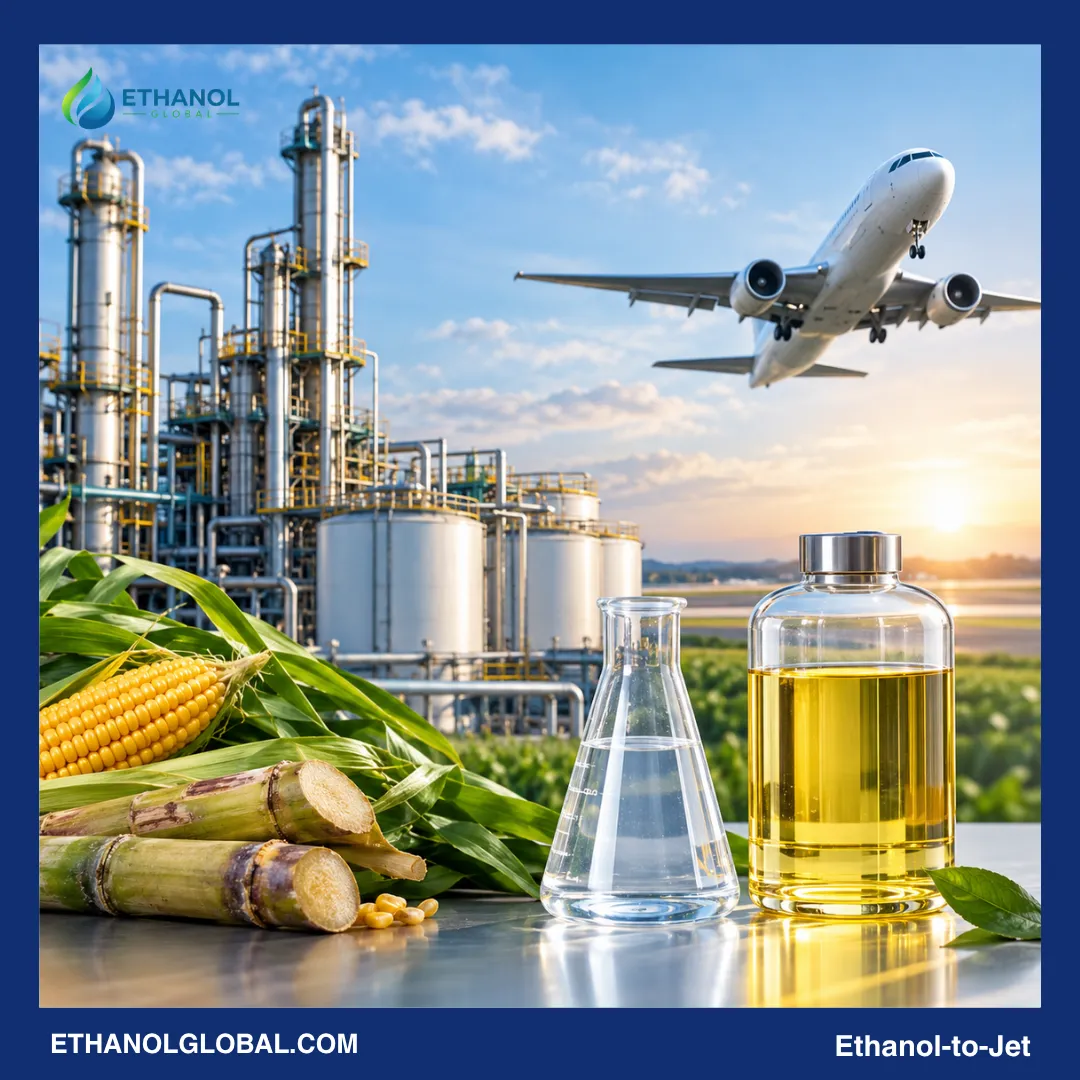
Ethanol-to-Jet is a conversion pathway that transforms ethanol into hydrocarbons suitable for aviation fuel production. Instead of using ethanol directly in aircraft, manufacturers process it through several chemical stages to create jet-range fuel components.
The process generally includes dehydration, which converts ethanol into ethylene; oligomerization, which combines smaller molecules into longer hydrocarbon chains; and further upgrading, including hydrogenation and hydrotreatment, to produce suitable fuel components.
The resulting product must meet applicable aviation fuel specifications and blending requirements before commercial use. ETJ therefore offers an opportunity to use established ethanol production infrastructure while developing an additional market for renewable feedstocks.
Ethanol already has established applications in conventional fuel systems, as explained in our guide to ethanol for industrial and fuel applications. ETJ technology builds on this existing industry by converting ethanol into hydrocarbons suitable for aviation fuel production.
How Feedstock Quality Affects ETJ Production
Feedstock quality is a major consideration in the economics and performance of ethanol-to-jet production. Although ethanol from different sources may have the same nominal concentration, its production history, impurity profile, and environmental footprint can vary significantly.
Ethanol Purity and Impurity Control
Consistent ethanol quality supports stable operation in downstream conversion processes. Water content, residual organic compounds, and other impurities can affect process conditions, separation requirements, and the overall efficiency of the production chain.
For industrial buyers and ETJ manufacturers, quality control should include verified ethanol concentration, relevant impurity limits, batch consistency, and appropriate technical documentation. Specifications should match the requirements of the intended process rather than relying on purity percentage alone.
Renewable Feedstock Selection
Ethanol can be produced from different agricultural and biomass resources, including sugarcane, corn, and cellulosic materials. Each feedstock has a different production profile, supply chain, and potential carbon intensity.
Cellulosic ethanol, produced from agricultural residues or other non-food biomass, may offer environmental advantages in suitable production systems. However, collection, pretreatment, logistics, and processing can increase costs. Conventional crop-based ethanol may benefit from mature infrastructure, but its environmental performance depends on agricultural inputs, energy consumption, and land-use effects.
Consequently, selecting a feedstock requires a balance between availability, cost, conversion performance, and lifecycle greenhouse gas emissions.
Understanding Ethanol-to-Jet Conversion Costs
Conversion costs are another major factor determining whether ETJ can compete with conventional jet fuel and other SAF production pathways.
Energy Consumption and Processing Efficiency
ETJ production requires energy for chemical conversion, separation, hydrogenation, and product upgrading. Energy prices and the efficiency of individual processing stages can significantly influence the final fuel cost.
Manufacturers can improve economic performance by optimizing reaction conditions, recovering heat, integrating processes, and reducing energy losses. Access to lower-carbon electricity and hydrogen may also improve the environmental profile of the final product, although these options can require additional investment.
Capital Investment and Infrastructure
Commercial ETJ facilities require specialized equipment, catalysts, process control systems, and infrastructure for handling and storing feedstocks and finished products.
Building a new facility can involve substantial capital expenditure. Integrating ETJ operations with an existing ethanol plant or refinery may reduce some infrastructure requirements, depending on site conditions, process design, and available utilities.
Project developers should evaluate capital costs alongside operating expenses, maintenance, catalyst replacement, financing, and expected production volumes. A competitive business case depends on the complete production system rather than the cost of ethanol alone.
By-Product Value and Plant Integration
The economic performance of ETJ can improve when producers identify useful outlets for co-products and integrate energy systems across the facility. Heat recovery, shared utilities, and efficient use of intermediate streams can help reduce overall operating costs.
However, these benefits depend on the specific process configuration and local market conditions. Each project requires a detailed techno-economic assessment before investment decisions are made.
Growing Demand for Sustainable Aviation Fuel
Demand for sustainable aviation fuel is influenced by airline decarbonization strategies, government policies, fuel availability, and the cost difference between SAF and conventional jet fuel.
The International Air Transport Association (IATA) identifies high production costs, limited infrastructure, and the need to scale up supply as major challenges for the SAF market. Its global feedstock assessment also highlights the importance of developing multiple production pathways to meet future aviation fuel requirements.
ETJ could contribute to this expansion by using ethanol as an intermediate feedstock. Because ethanol is already produced commercially at scale, the technology may help diversify SAF supply beyond pathways that depend heavily on limited supplies of oils and fats.
Nevertheless, future demand does not automatically guarantee profitability. Producers must consider long-term purchasing agreements, certification requirements, regional regulations, and the ability to deliver fuel at a competitive price.
Sustainability and Carbon Intensity
The environmental value of ethanol-to-jet fuel depends on its lifecycle greenhouse gas emissions, not simply on whether its feedstock is renewable.
Important contributors include agricultural production, fertilizer use, ethanol manufacturing, transportation, conversion energy, hydrogen production, and potential land-use change. Using low-carbon energy, improving process efficiency, and selecting suitable feedstocks can help reduce lifecycle emissions.
Producers should therefore assess carbon intensity across the entire supply chain and maintain reliable records of feedstock origin, energy use, and production methods. These measures can support sustainability verification and help demonstrate compliance with applicable market requirements.
What ETJ Means for Ethanol Producers and Buyers
ETJ creates a potential additional market for ethanol producers, particularly those able to provide consistent quality, dependable volumes, and transparent sustainability information.
Before entering this market, producers should evaluate:
- Product quality: Maintain consistent ethanol specifications and documented quality-control procedures.
- Supply reliability: Establish dependable feedstock sourcing, production planning, and logistics.
- Cost competitiveness: Monitor ethanol prices, energy costs, conversion efficiency, and capital requirements.
- Sustainability documentation: Track feedstock origin and lifecycle emissions using appropriate assessment methods.
- Market access: Understand the technical certification, blending, and regulatory requirements applicable to the target market.
For industrial suppliers, these factors can help identify opportunities to serve evolving fuel markets. However, ETJ projects require specialized conversion facilities, and ordinary industrial ethanol is not itself a finished aviation fuel.
Conclusion
Ethanol-to-Jet technology offers a potential route for expanding sustainable aviation fuel production and creating new demand for ethanol. Its commercial viability depends on feedstock quality, efficient conversion processes, capital investment, and sustained demand from airlines and fuel suppliers.
For the industry to scale successfully, producers must combine reliable ethanol supply with competitive processing technology and measurable lifecycle emissions reductions. As SAF markets develop, companies that understand these technical and economic requirements will be better positioned to evaluate opportunities in the emerging ETJ value chain.
Looking for a Reliable Ethanol Supplier?
Ethanol Global supplies ethanol for industrial applications and international markets. Contact our team to request a price quotation, discuss product specifications, or inquire about bulk supply and export opportunities.