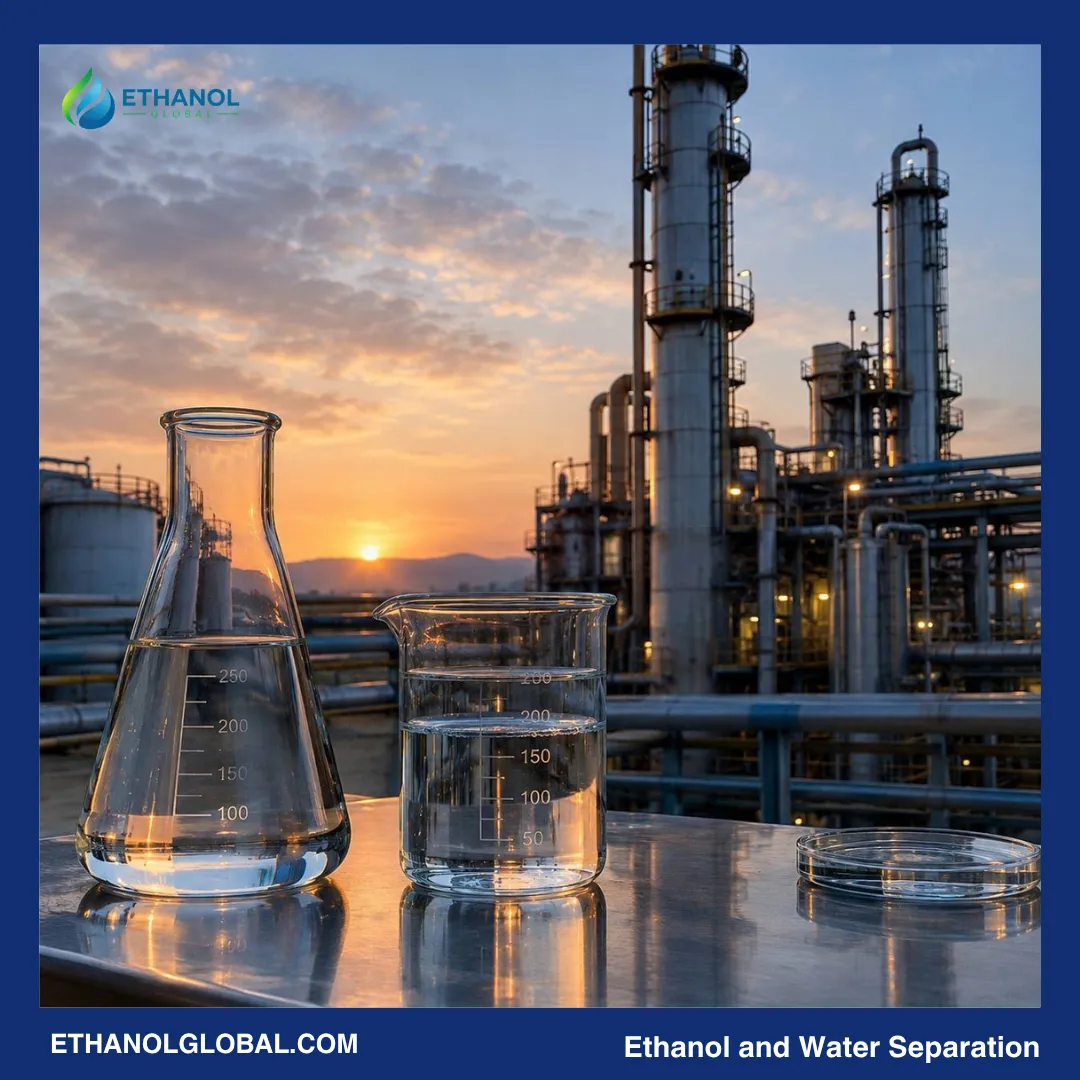
Ethanol and water separation is an important process in industries that require high-purity ethanol. Although distillation can separate these liquids, their azeotropic behavior creates a technical limitation that conventional distillation cannot overcome at a fixed pressure.
Understanding this limitation helps manufacturers select efficient dehydration technologies, improve product purity, and control operating costs.
What Is an Ethanol-Water Azeotrope?
An azeotrope is a liquid mixture that boils at a constant temperature and produces vapor with the same composition as the liquid under specified pressure conditions. As a result, ordinary fractional distillation cannot separate the mixture beyond its azeotropic composition.
For a detailed overview of industrial ethanol production, distillation, and dehydration, read our guide to the ethanol production process.
At atmospheric pressure, ethanol and water form an azeotrope containing approximately 95.6% ethanol by mass. This composition represents a practical limit for conventional distillation.
Therefore, industries that require nearly anhydrous ethanol must use additional separation technologies.
Why Azeotropic Behavior Matters in Industrial Processing
Azeotropic behavior directly affects ethanol production, energy consumption, and final product quality.
First, conventional distillation becomes insufficient when manufacturers need ethanol with very low water content. Second, additional processing increases equipment requirements and operating expenses. Finally, the chosen dehydration method influences production capacity, energy efficiency, and process reliability.
For pharmaceutical, chemical, and industrial applications, selecting the correct separation method is essential to meeting product specifications.
Common Methods for Ethanol and Water Separation
Several technologies can overcome the limitations of conventional distillation. Each method offers different advantages depending on the required purity and production scale.
Several advanced technologies can overcome the limitations of conventional distillation, as explained in this scientific review of ethanol-water azeotrope separation.
1. Molecular Sieve Dehydration
Molecular sieve dehydration is widely used to produce high-purity ethanol. These materials contain pores that selectively adsorb water molecules while allowing ethanol to pass through.
Industrial systems commonly use pressure swing adsorption or alternating adsorption beds to maintain continuous production. When one bed captures water, another can undergo regeneration.
This method is suitable for producing anhydrous ethanol while minimizing the need for additional distillation stages.
2. Azeotropic Distillation
Azeotropic distillation introduces an additional component, known as an entrainer, to change the separation behavior of the mixture. This approach enables water removal beyond the ordinary ethanol-water azeotropic limit.
However, the process requires careful solvent selection, recovery systems, and environmental controls. Modern process design must also consider entrainer toxicity, solvent losses, and overall energy consumption.
3. Extractive Distillation
Extractive distillation uses a high-boiling solvent to modify the relative volatility of ethanol and water. This change makes separation possible under conditions where conventional distillation would be limited.
The method can be effective for large-scale production, although solvent recovery and energy demand must be evaluated during process design.
4. Membrane Separation
Membrane technologies, including pervaporation, can selectively remove water from ethanol mixtures. In pervaporation, the feed contacts a selective membrane, and part of the mixture passes through as vapor under a pressure or chemical-potential difference.
Membrane systems can reduce energy consumption in suitable applications and may complement conventional distillation. Their performance depends on membrane selectivity, operating conditions, durability, and feed composition.
How to Choose the Right Separation Technology
Selecting an appropriate method for ethanol and water separation requires evaluating several technical and economic factors.
- Required ethanol purity: Determine the final water-content specification before selecting the technology.
- Production capacity: Compare equipment requirements and operating performance at the intended scale.
- Energy consumption: Evaluate heating, cooling, vacuum generation, and regeneration requirements.
- Operating costs: Include utilities, maintenance, solvent replacement, and equipment lifecycle costs.
- Environmental and safety requirements: Assess solvent handling, emissions, waste management, and process hazards.
A reliable design balances product quality with energy efficiency, operational stability, and total production costs.
Conclusion
Ethanol and water separation becomes more challenging when the mixture reaches its azeotropic composition. Because conventional distillation cannot independently overcome this limitation, manufacturers rely on molecular sieves, azeotropic distillation, extractive distillation, or membrane technologies.
Ultimately, the best solution depends on the required ethanol purity, production scale, energy costs, and process conditions. Understanding azeotropic behavior allows industrial producers to make better decisions and achieve consistent product quality.
For industrial ethanol supply, choosing a producer that can meet defined purity specifications and provide appropriate product documentation is equally important.
Looking for reliable industrial ethanol solutions? Ethanol Global is your trusted partner for high-quality ethanol products, consistent purity, and dependable export services tailored to your business needs.