


Introduction
Diethyl ether is an important organic solvent and chemical intermediate used in several industrial sectors. It is valued for its high volatility, low boiling point, and ability to dissolve a wide range of organic compounds. One of the established methods for producing this compound involves the catalytic dehydration of ethanol.
Diethyl ether production from Ethanol 96% offers an interesting opportunity to convert an established industrial alcohol into a higher-value chemical product. However, achieving high product selectivity requires careful control of reaction conditions, catalyst properties, and feedstock quality.
This article examines the main catalytic routes, reaction selectivity factors, and industrial applications of diethyl ether produced from ethanol.
1. Understanding Diethyl Ether Production from Ethanol
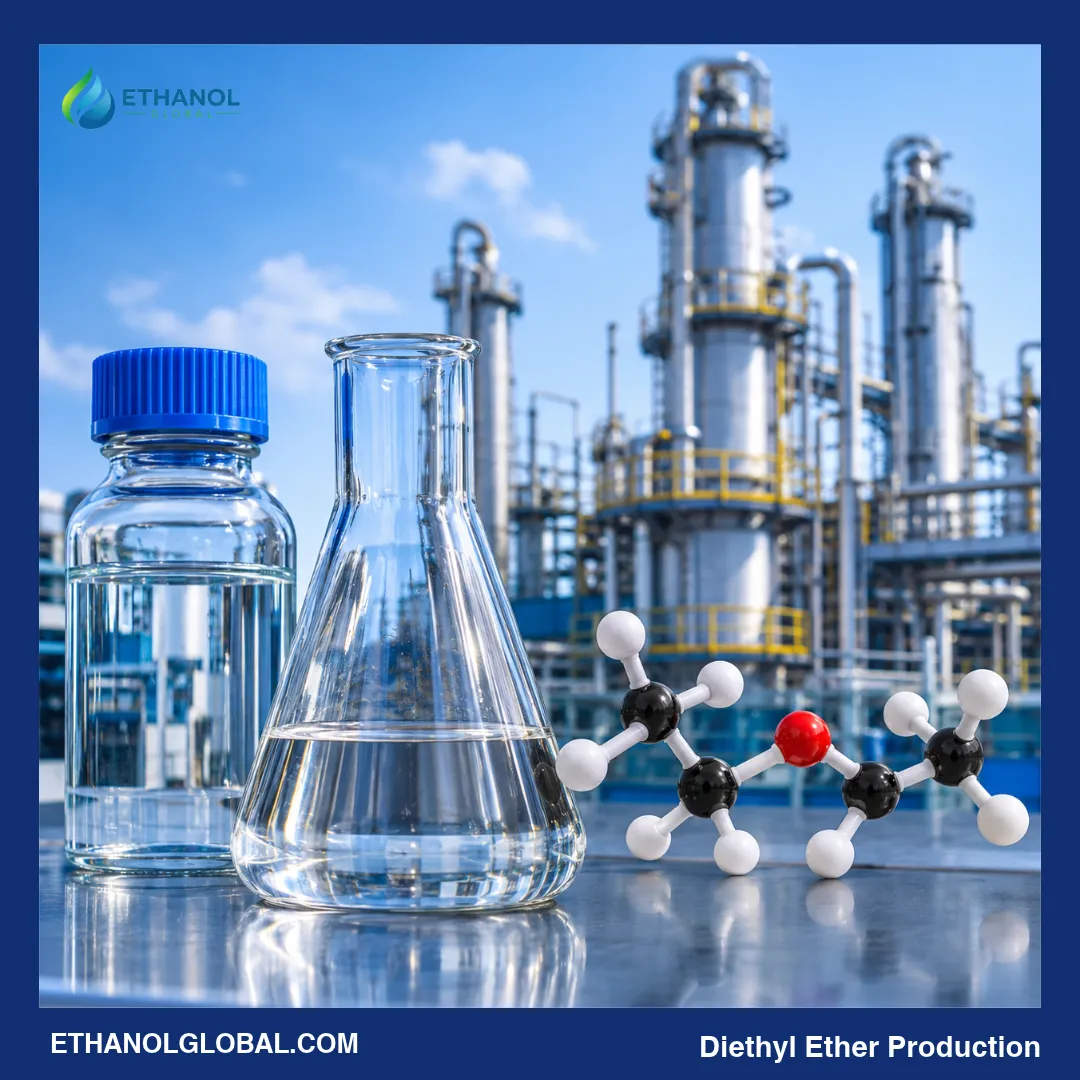
Diethyl ether (C4H10O), also known as ethoxyethane, is produced through an acid-catalyzed dehydration reaction involving two ethanol molecules.
The overall chemical reaction is:
2C2H5OH → C2H5OC2H5 + H2O
In this process, ethanol molecules react in the presence of an acidic catalyst to form diethyl ether and water.
Ethanol 96% can serve as a feedstock for this process. Nevertheless, its water content must be considered because water can influence catalyst performance, reaction equilibrium, and product separation.
Therefore, feedstock preparation is an important step in achieving consistent production quality.
2. Main Catalytic Routes for Diethyl Ether Production
Catalyst selection plays a major role in determining reaction efficiency and product distribution. Several types of acidic catalysts have been studied for ethanol dehydration.
2.1 Sulfuric Acid Catalysis
Sulfuric acid is a traditional catalyst used in the dehydration of ethanol. Under suitable conditions, it promotes the formation of diethyl ether.
This method has historical industrial importance. However, corrosion concerns, acid handling requirements, and waste management can increase operating complexity.
2.2 Alumina-Based Catalysts
Activated alumina is another important catalyst for ethanol dehydration. Its acidic surface sites facilitate the conversion of ethanol into ether products.
Alumina-based catalysts are particularly relevant to heterogeneous catalytic processes because they can simplify catalyst separation and support continuous operation.
2.3 Zeolite Catalysts
Zeolites are crystalline porous materials with adjustable acidity and pore structures. These characteristics make them useful for controlling catalytic reactions.
Their catalytic properties can influence conversion, product distribution, and resistance to deactivation. However, operating conditions and catalyst composition must be optimized to obtain the desired selectivity.
3. Reaction Selectivity and Operating Conditions
One of the main challenges in diethyl ether production is controlling selectivity.
Ethanol dehydration can produce different compounds depending on temperature, catalyst properties, and reaction conditions.
At relatively moderate temperatures, diethyl ether formation is generally favored. At higher temperatures, ethylene production becomes increasingly important.
Several factors influence the final product distribution:
- Reaction temperature: Temperature strongly affects the competition between ether formation and ethylene production.
- Catalyst acidity: Acid strength and the number of active sites influence reaction pathways.
- Feedstock composition: Water and trace impurities can affect catalyst activity.
- Contact time: The time that ethanol remains in contact with the catalyst influences conversion and secondary reactions.
- Catalyst stability: Deactivation can reduce production efficiency and change product selectivity.
Consequently, process optimization requires balancing ethanol conversion with high diethyl ether selectivity.
4. The Role of Ethanol 96% Feedstock Quality
Feedstock quality directly affects the reliability of chemical production processes.
Ethanol 96% contains approximately 96% ethanol and 4% water by volume under the specified measurement conditions. This water content should be considered during process design.
Before entering the reaction system, the feedstock may require appropriate preparation, depending on the selected catalyst and process configuration.
Important quality parameters include:
- Ethanol concentration and purity
- Water content
- Acidity and other chemical impurities
- Consistency between production batches
- Storage and transportation conditions
Reliable feedstock quality helps manufacturers maintain stable operating conditions and achieve consistent product specifications.
5. Industrial Applications of Diethyl Ether
Diethyl ether has several important industrial applications due to its solvent properties and volatility.
5.1 Pharmaceutical Manufacturing
Diethyl ether has historically been used as an extraction solvent in pharmaceutical and chemical manufacturing. Its ability to dissolve many organic compounds makes it useful in selected separation processes.
5.2 Chemical Processing
The chemical industry uses diethyl ether as a solvent in laboratory operations, organic synthesis, and selected industrial processes.
It can also serve as a reaction medium where its chemical properties are compatible with the process requirements.
5.3 Extraction and Separation
Diethyl ether is useful in liquid-liquid extraction because of its ability to dissolve many organic substances while having limited miscibility with water.
This property makes it valuable in certain purification and separation operations.
5.4 Specialty Chemical Manufacturing
Some specialty chemical manufacturers use diethyl ether in controlled synthesis and processing applications. Its suitability depends on the reaction system, safety requirements, and product specifications.
6. Production Challenges and Safety Considerations
Despite its industrial value, diethyl ether production involves several operational challenges.
The product has a low boiling point and is highly flammable. It can also form explosive peroxides during prolonged storage when exposed to air and light.
Manufacturers should therefore consider:
- Closed production and transfer systems
- Appropriate ventilation and explosion protection
- Temperature and pressure monitoring
- Suitable storage containers
- Regular peroxide testing and controlled storage periods
- Compliance with applicable chemical safety regulations
Furthermore, catalyst deactivation, corrosion, and separation costs should be evaluated when selecting a production technology.
7. Economic Factors Affecting Diethyl Ether Production
The economic performance of diethyl ether production depends on several interconnected factors.
The most important cost components include:
- Ethanol 96% feedstock prices
- Catalyst purchase and replacement costs
- Energy consumption during reaction and separation
- Equipment investment and maintenance
- Product purification and storage expenses
- Transportation and packaging costs
In addition, market demand and the selling price of diethyl ether influence overall profitability.
For manufacturers, evaluating feedstock costs alongside product yield and selectivity is essential. A process with high ethanol conversion does not necessarily provide the best economic results if it produces significant quantities of unwanted by-products.
Conclusion
Diethyl ether production from Ethanol 96% represents a valuable route for converting industrial ethanol into a higher-value chemical product. Catalytic dehydration using sulfuric acid, alumina-based materials, and zeolites offers different opportunities for industrial process development.
However, product selectivity depends on catalyst properties, reaction temperature, feedstock quality, and operating conditions. Manufacturers must also consider purification requirements, energy consumption, and the safety challenges associated with highly flammable ether products.
With proper process optimization and reliable ethanol sourcing, diethyl ether production can support a range of industrial solvent and specialty chemical applications.
Looking for Reliable Ethanol 96% Supply?
Choosing high-quality Ethanol 96% is an important step in maintaining consistent performance in industrial chemical production. Ethanol Global is a producer and exporter of Ethanol 96%, supplying industrial buyers with reliable product quality and export services.
For product specifications, a Certificate of Analysis (COA), or the latest price quotation, contact our sales team today.