Introduction
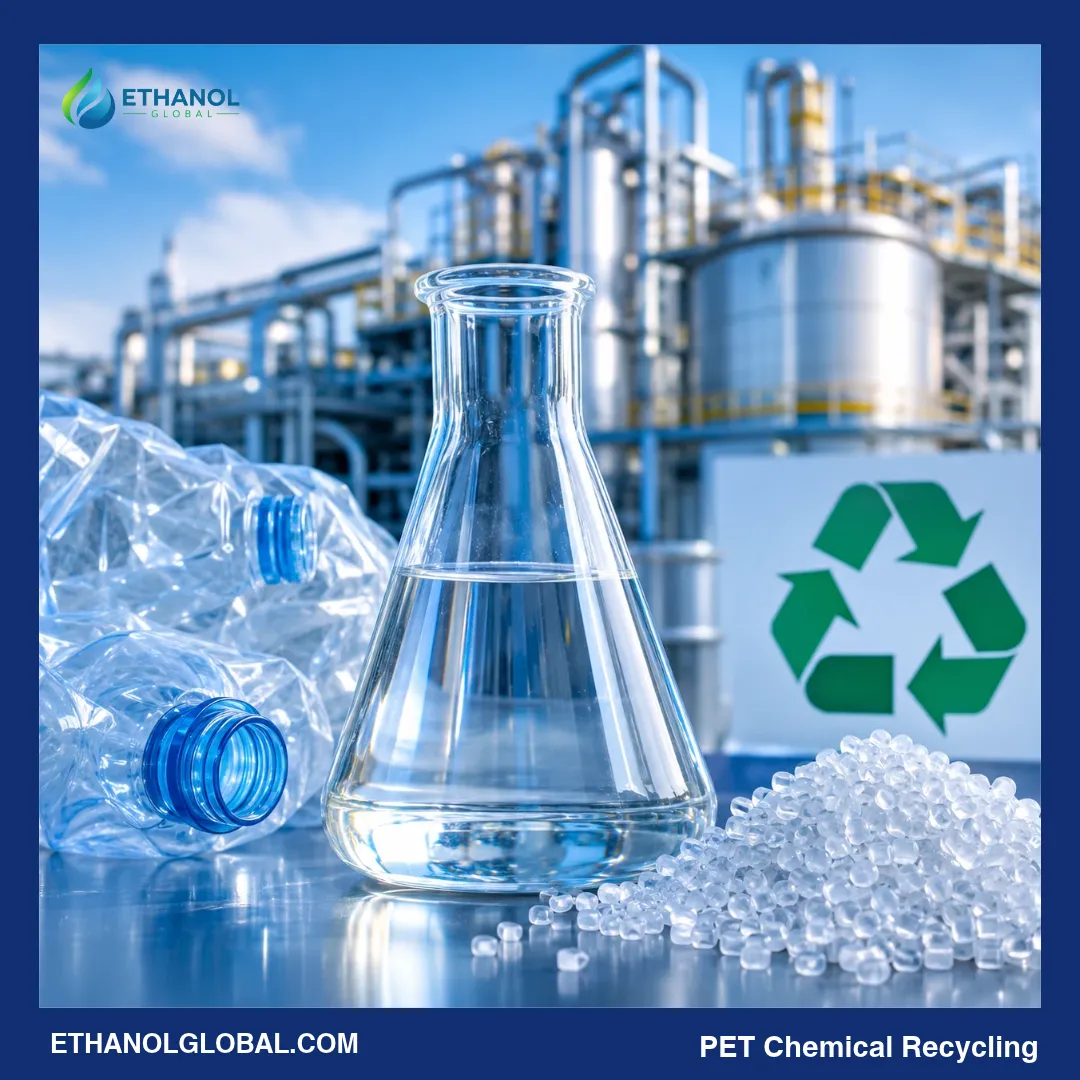
Polyethylene terephthalate (PET) is widely used in beverage bottles, food packaging, polyester fibers, and industrial films. However, the growing volume of PET waste has increased the demand for efficient recycling technologies. Although mechanical recycling remains an established solution, repeated processing can reduce material quality and limit the reuse of contaminated or mixed plastic waste.
Chemical recycling offers another approach by breaking down PET into valuable chemical intermediates that can be purified and reused. One promising route is ethanolysis, a type of alcoholysis in which ethanol reacts with PET ester bonds to produce recoverable chemical compounds.
Ethanol 96% can serve as a feedstock for this process when its water content and purity are properly controlled. The resulting products, particularly diethyl terephthalate (DET) and ethylene glycol (EG), provide opportunities for recovering valuable materials and supporting circular polymer production.
1. Understanding PET Chemical Recycling Through Ethanolysis
PET is a polyester containing repeating units connected through ester bonds. These bonds can be broken through chemical reactions under controlled temperature, pressure, and catalytic conditions.
In ethanolysis, ethanol acts as the alcohol reactant and participates in a transesterification reaction. During this process, ethyl groups replace the original glycol-related groups in the polymer structure, resulting in the formation of diethyl terephthalate.
The simplified reaction can be represented as:
PET + 2n Ethanol → n Diethyl Terephthalate + n Ethylene Glycol
The main products are:
- Diethyl Terephthalate (DET): An aromatic ester that can serve as an intermediate for producing terephthalate-based materials.
- Ethylene Glycol (EG): A valuable chemical used in polyester and PET manufacturing.
Experimental studies have demonstrated that PET depolymerization using subcritical and supercritical ethanol can produce different chemical monomers depending on operating conditions, including temperature, pressure, and reaction time.
Unlike mechanical recycling, ethanolysis changes the chemical structure of PET waste and allows the recovery of molecular building blocks. This makes the technology particularly interesting for integrated recycling systems.
2. The Role of Ethanol 96% in PET Depolymerization
Ethanol 96% contains approximately 96% ethanol and 4% water by volume under the specified concentration basis. Its suitability for PET ethanolysis depends on the reaction design, operating conditions, and required product specifications.
For industrial applications, evaluating Ethanol 96% specifications is essential to ensure consistent quality, control impurities, and determine whether the product meets specific process requirements.
Several factors determine its performance.
Ethanol Concentration and Water Content
Ethanol concentration influences the composition of the reaction medium. Water can participate in competing hydrolysis reactions, potentially changing the product distribution and increasing separation requirements.
Therefore, controlling the water content of Ethanol 96% is important when designing an ethanolysis process. Some processes may require more concentrated ethanol to achieve their target selectivity, while others may be specifically designed to tolerate a certain amount of water.
Solvent-to-PET Ratio
The ethanol-to-PET ratio affects polymer swelling, contact between reactants, and reaction efficiency. An adequate ethanol concentration can improve mass transfer and provide sufficient reactant availability.
However, excessive ethanol consumption increases solvent recovery requirements and energy costs. Industrial optimization should therefore balance PET conversion, product yield, and solvent circulation.
Reaction Temperature and Pressure
PET has a relatively stable polymer structure, so ethanolysis generally requires elevated temperatures. Depending on the selected technology, reactions may operate under pressurized or subcritical conditions.
The operating pressure must maintain the required reaction phase and prevent uncontrolled solvent vaporization. Temperature and pressure also influence reaction kinetics and product selectivity.
3. Alcoholysis Chemistry and Catalytic Systems
The chemical recycling of PET through ethanolysis involves the cleavage of ester bonds and the formation of new ester products.
Catalysts can accelerate this reaction by facilitating nucleophilic attack on the carbonyl groups of PET. Their selection depends on reaction conditions, product purity requirements, and downstream separation technology.
Common catalytic approaches include:
Metal-Based Catalysts
Metal salts and metal-based compounds can promote ester exchange reactions. Their catalytic performance depends on the metal center, concentration, reaction temperature, and compatibility with the solvent.
Catalyst selection is particularly important because residual metals may contaminate the recovered products or interfere with subsequent polymerization.
Homogeneous Catalysts
Homogeneous catalysts dissolve in the reaction medium and provide relatively uniform contact with reactants. However, separating them from the final product can be challenging.
Additional purification or catalyst deactivation steps may be necessary to prevent unwanted reactions during product recovery.
Heterogeneous Catalysts
Heterogeneous catalysts remain in a separate solid phase, making filtration and potential catalyst reuse possible.
Nevertheless, catalyst stability, surface fouling, and reduced activity during repeated operation must be evaluated before industrial implementation.
4. PET Feedstock Preparation and Pretreatment
The quality of PET waste has a direct effect on ethanolysis performance. Post-consumer bottles, packaging films, and polyester textiles may contain labels, adhesives, pigments, additives, and other polymers.
Before entering the reaction system, PET waste generally requires several preparation steps.
- Sorting: Separating PET from incompatible plastics and other waste materials.
- Washing: Removing dirt, food residues, adhesives, and surface contaminants.
- Size Reduction: Cutting or shredding PET into smaller flakes to improve contact with ethanol.
- Drying: Reducing excess moisture to improve control over the reaction medium.
- Feedstock Inspection: Evaluating polymer composition, contamination levels, and particle size.
Effective pretreatment reduces unwanted side reactions and improves the consistency of the resulting chemical products.
5. Product Recovery and Purification
Product recovery is one of the most important stages in PET ethanolysis. Even when the polymer reaches a high conversion rate, the process must separate the desired products from unreacted ethanol, catalysts, impurities, and other reaction components.
Diethyl Terephthalate Recovery
DET is the primary aromatic product of PET ethanolysis. After the reaction, it must be separated from the liquid mixture and purified to meet the requirements of downstream applications.
Distillation can be used to separate volatile components, while crystallization or other suitable purification techniques may be considered depending on the composition of the reaction mixture.
The required purity depends on whether DET will be used as a chemical intermediate or as a feedstock for further polymer production.
Ethylene Glycol Separation
Ethylene glycol is another valuable product of PET depolymerization. Its recovery requires separation from water, residual ethanol, catalysts, and other soluble impurities.
Distillation is commonly considered for separating glycol-containing streams, although the final purification strategy depends on the process configuration and product specifications.
Recovered EG may be suitable for reuse in polyester production after appropriate purification and quality verification.
Ethanol Recovery and Reuse
Recovering unreacted ethanol is essential for improving the economics of the process.
Distillation and solvent condensation systems can recover ethanol for reuse in subsequent reaction cycles. However, accumulated water and impurities may require additional treatment before the recovered solvent can return to the reactor.
An efficient solvent recovery system reduces fresh ethanol consumption, operating expenses, and wastewater generation.
6. Main Process Challenges in PET Ethanolysis
Despite its potential, PET ethanolysis faces several technical and economic challenges that must be addressed before large-scale commercial deployment.
Water Management
Water in Ethanol 96% and moisture in PET feedstock can influence reaction pathways and product distribution. Excessive water may increase hydrolysis and complicate the recovery of the desired ester products.
Careful moisture control and solvent conditioning are therefore important parts of process design.
Energy Consumption
Elevated reaction temperatures and solvent recovery operations require significant energy input. Heating the reaction mixture, maintaining pressure, and separating ethanol from the products can increase operating costs.
Heat integration, energy-efficient distillation, and optimized reactor design can help reduce these requirements.
Catalyst Recovery and Reuse
Catalyst consumption contributes to operating expenses. Homogeneous catalysts may require additional separation, while heterogeneous catalysts can experience deactivation or contamination.
Developing stable catalysts with high activity and good recyclability remains an important research objective.
Feedstock Contamination
Mixed plastic waste, dyes, adhesives, and additives can affect product purity and complicate downstream processing.
Although chemical recycling can offer greater flexibility than conventional mechanical recycling, feedstock characterization and pretreatment remain essential.
Process Scale-Up
Laboratory results do not automatically translate into reliable industrial performance. Large-scale systems must address heat transfer, mixing, pressure control, reactor fouling, solvent circulation, and continuous product separation.
Pilot-scale testing is therefore necessary to evaluate long-term performance and determine the economic feasibility of commercial operation.
7. Industrial Applications of Recovered Products
The products obtained through PET ethanolysis can support several industrial value chains.
Recycled PET Production
Purified DET can undergo further chemical conversion and polycondensation with ethylene glycol to produce recycled PET.
This pathway offers an opportunity to return PET waste to polymer production rather than converting it into lower-value materials.
Polyester Manufacturing
Ethylene glycol recovered from the recycling process can be used as a chemical feedstock in polyester manufacturing, provided that its purity meets the required specifications.
Aromatic Ester Intermediates
DET is an important aromatic ester intermediate that can be used in further chemical synthesis and investigated as a feedstock for producing terephthalate-based materials.
The economic value of these products depends on their purity, market demand, and the cost of purification.
8. Improving the Efficiency of Ethanol-Based PET Recycling
Industrial optimization requires evaluating the entire process rather than focusing only on PET conversion.
Several strategies can improve overall efficiency:
- Optimizing Ethanol Concentration: Selecting an appropriate ethanol specification based on reaction chemistry and water tolerance.
- Improving Catalyst Performance: Using catalysts that provide high activity, selectivity, and stability.
- Enhancing Solvent Recovery: Recovering and recycling ethanol to reduce fresh solvent consumption.
- Integrating Heat Recovery: Reusing thermal energy from hot process streams to reduce heating requirements.
- Improving Feedstock Preparation: Removing contaminants and controlling PET particle size and moisture.
- Monitoring Product Quality: Measuring DET purity, EG composition, and residual catalyst content.
Process optimization should consider PET conversion, DET yield, solvent recovery efficiency, product purity, and total energy consumption together.
Conclusion
Ethanolysis represents a promising chemical recycling pathway for converting PET waste into valuable chemical intermediates. By using ethanol as a reactant, the process can produce diethyl terephthalate and ethylene glycol, both of which have potential applications in chemical and polyester manufacturing.
Ethanol 96% can be considered as a potential feedstock for this technology, although its water content must be evaluated against the specific reaction requirements. Effective catalyst selection, feedstock pretreatment, product purification, and solvent recovery are essential for achieving reliable process performance.
As industrial interest in circular plastics increases, ethanol-based PET recycling may provide additional opportunities for recovering valuable materials and reducing dependence on virgin petrochemical feedstocks.
Request a Quotation for Ethanol 96%
Looking for a reliable Ethanol 96% producer and exporter for your industrial applications? Ethanol Global supplies Ethanol 96% for various industrial requirements, with product specifications and quality documentation available upon request.
Contact our team today to request a competitive price quotation or receive the Certificate of Analysis (COA) for Ethanol 96%.
Contact Us to discuss your requirements and explore our ethanol supply solutions.