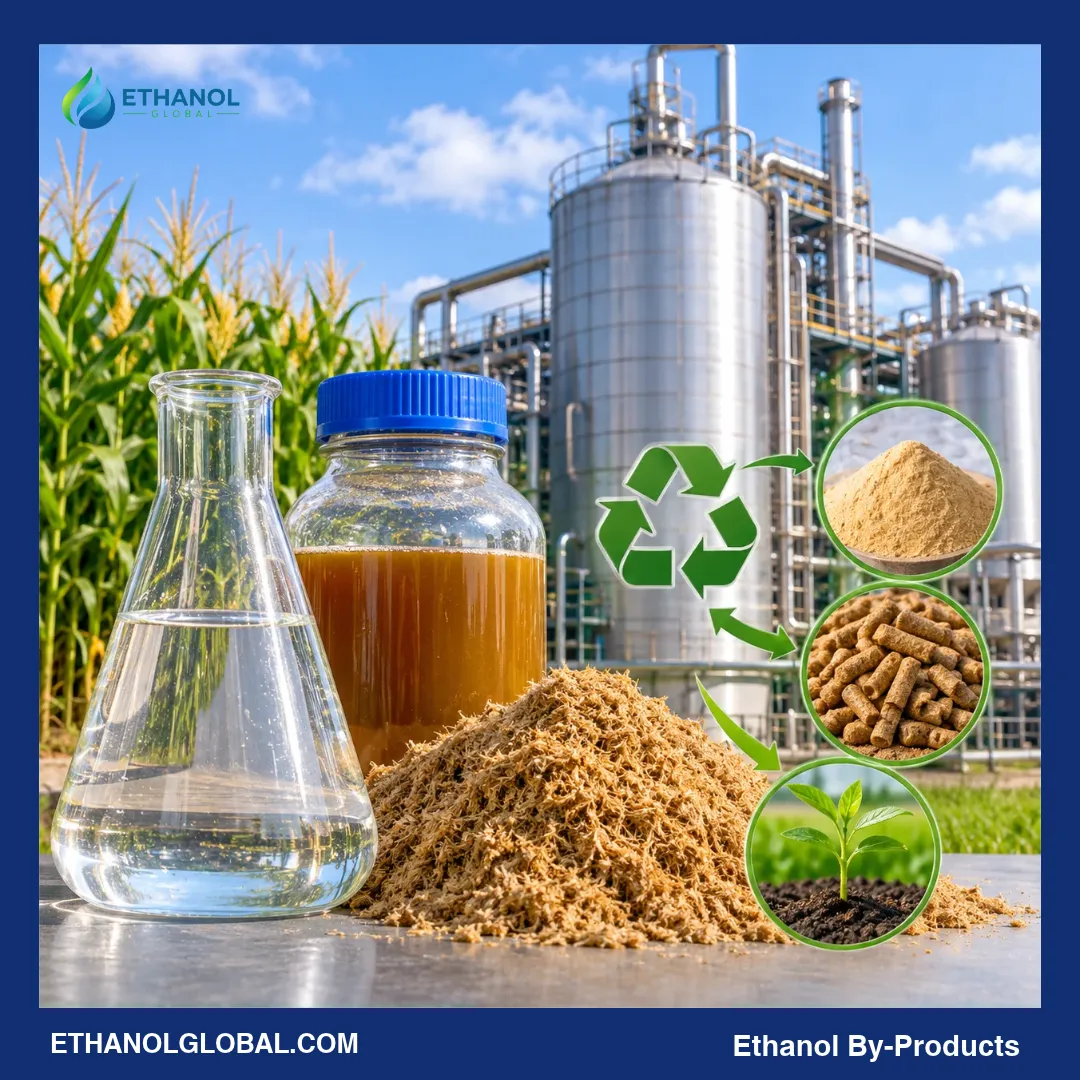
The production of Ethanol 96% creates several by-products that can provide additional economic and environmental benefits. Although ethanol remains the primary product, fermentation residues, stillage, and residual biomass contain valuable materials that manufacturers can recover and reuse. Therefore, managing these streams effectively is an important part of modern ethanol production.
Ethanol by-products can serve as resources for animal feed, renewable energy, fertilizers, and industrial applications. Instead of treating every residual stream as waste, producers can apply suitable recovery technologies to improve resource efficiency, reduce disposal costs, and support sustainable manufacturing.
1. Understanding By-Products in Ethanol Production
Ethanol production involves several stages, including feedstock preparation, fermentation, distillation, and product recovery. During these operations, different residual streams are generated.
For a detailed overview of these manufacturing stages, read our guide to the ethanol production process, which explains the main operations involved in producing Ethanol 96%.
Their composition depends on the original feedstock, fermentation conditions, and production technology. For example, grain-based ethanol facilities generate protein-rich solids and liquid residues. In contrast, sugar-based and cellulosic processes produce different combinations of organic compounds and biomass.
The main by-products include:
- Stillage: The liquid residue remaining after ethanol distillation.
- Residual biomass: Unconverted fibers, proteins, and other solid materials.
- Fermentation residues: Remaining nutrients, microbial biomass, and organic compounds.
- Process wastewater: Water streams containing dissolved organic substances.
- Carbon dioxide: A fermentation product that can be collected and used in suitable industrial applications.
Identifying these streams is the first step toward effective resource recovery.
2. Stillage Valorization and Its Industrial Potential
Stillage is one of the most significant by-products of ethanol production. It contains water, suspended solids, proteins, organic acids, minerals, and residual carbohydrates.
However, its composition varies depending on the feedstock and production process. Consequently, manufacturers must evaluate its characteristics before selecting a recovery method.
Several technologies can convert stillage into useful products.
Animal Feed Production
One established application involves separating stillage into liquid and solid fractions. Centrifugation and filtration help recover these materials for further processing.
In grain-based ethanol production, wet distillers’ grains can be dried and marketed as distillers dried grains (DDG). Manufacturers can also combine concentrated liquid solubles with these solids to produce distillers dried grains with solubles (DDGS).
These products contain valuable nutrients, including protein and fiber. Therefore, they can serve as ingredients in livestock feed when their nutritional quality and safety meet the relevant requirements. Research on value-added products from ethanol fermentation also highlights the potential for recovering proteins, fibers, and other valuable compounds from fermentation residues.
Biogas Production
Another important approach is anaerobic digestion. In this process, microorganisms break down biodegradable organic matter in the absence of oxygen.
As a result, the system produces biogas, which mainly contains methane and carbon dioxide. Ethanol facilities can use the recovered methane as a renewable energy source for heating and other plant operations.
Moreover, anaerobic digestion can reduce the organic load of stillage. This treatment makes it easier to manage the remaining wastewater.
Fertilizer and Nutrient Recovery
Stillage also contains nitrogen, potassium, phosphorus, and other nutrients. After appropriate treatment and quality assessment, some recovered fractions can support agricultural applications.
However, direct land application requires careful management. Excessive nutrient concentrations and unsuitable application rates may cause soil and water pollution.
3. Recovering Value from Residual Biomass
Residual biomass represents another important category of ethanol by-products. It includes unconverted feedstock components, plant fibers, proteins, and other organic solids.
Rather than disposing of these materials, producers can investigate several recovery pathways.
Biomass-Based Energy Generation
Some residual biomass contains significant amounts of organic matter. Therefore, suitable fractions can be processed through anaerobic digestion or thermal conversion technologies.
For example, biomass combustion can generate heat for industrial operations. In addition, certain organic residues can serve as feedstock for further bioenergy production.
The selected technology depends on moisture content, chemical composition, energy requirements, and processing costs.
Extraction of Valuable Components
Residual biomass may also contain proteins, fibers, and other compounds with commercial potential.
Through separation, extraction, and fractionation, manufacturers can recover selected components for industrial or agricultural applications.
Furthermore, these processes may create additional revenue opportunities. However, their economic feasibility depends on product quality, recovery efficiency, and market demand.
4. Reusing Process Streams in Ethanol Manufacturing
Not all residual streams require conversion into separate commercial products. Some can return to the production process after suitable treatment.
For instance, certain liquid fractions from stillage processing can be recycled as process water. This approach may reduce freshwater consumption and lower wastewater generation.
However, recycling requires careful control of dissolved salts, organic acids, suspended solids, and other accumulated compounds.
Without proper management, these substances may interfere with fermentation performance and reduce process efficiency.
Therefore, ethanol manufacturers should evaluate water quality and establish suitable recycling limits.
Other recovery opportunities include:
- Recovering heat from hot process streams.
- Reusing treated water in compatible operations.
- Recovering nutrients from liquid residues.
- Capturing and utilizing fermentation carbon dioxide.
- Separating valuable compounds before wastewater treatment.
Together, these strategies support more efficient resource utilization.
5. Environmental Benefits of By-Product Valorization
Effective management of ethanol by-products can improve the environmental performance of production facilities.
First, recovering useful materials reduces the volume of waste requiring final disposal. This approach can also lower the environmental risks associated with untreated organic wastewater.
Second, converting suitable residues into biogas provides an alternative energy source. Consequently, facilities may reduce their dependence on conventional fuels.
In addition, recovering nutrients and reusable water supports more efficient resource management.
Nevertheless, each recovery method requires an environmental assessment. Energy consumption, chemical requirements, transportation, emissions, and residual waste must all be considered.
6. Economic Advantages for Ethanol Producers
By-product recovery can improve the financial performance of ethanol manufacturing facilities.
Although installing separation and recovery equipment requires investment, the resulting products may create additional income streams.
The main economic benefits include:
- Additional revenue: Selling suitable co-products can generate income beyond ethanol sales.
- Lower disposal expenses: Recovering useful materials can reduce waste treatment and disposal requirements.
- Energy savings: Biogas and recovered process heat may reduce energy costs.
- Improved resource efficiency: Water and nutrient recovery can lower raw material consumption.
- Better operational performance: Integrated recovery systems can improve the overall utilization of feedstock.
However, producers should conduct a detailed cost-benefit analysis before investing in new technologies. Equipment costs, energy prices, product quality, and access to target markets all influence profitability.
7. Challenges in Ethanol By-Products Recovery
Despite its advantages, by-product valorization involves several technical and economic challenges.
The composition of residual streams can change with feedstock quality and operating conditions. Therefore, recovery systems must accommodate variations in organic content, moisture, acidity, and nutrient concentrations.
Furthermore, some technologies require substantial energy or specialized equipment. For example, drying wet biomass can increase operating costs, while anaerobic digestion requires careful control of organic loading and process stability.
Market demand also plays an important role. Recovered products must meet relevant quality standards before manufacturers can sell them to industrial or agricultural customers.
For these reasons, successful valorization requires an integrated approach that considers technical performance, environmental impact, and commercial feasibility.
8. The Future of Integrated Ethanol Production
The future of ethanol manufacturing increasingly depends on improving the efficiency of the entire production chain.
Modern biorefinery concepts aim to recover multiple products from a single feedstock. Instead of focusing exclusively on ethanol output, these systems integrate energy generation, nutrient recovery, biomass processing, and water recycling.
Furthermore, advances in separation technologies and biological treatment may improve the recovery of valuable compounds from complex residual streams.
As a result, ethanol manufacturers can move toward more resource-efficient production models while creating additional commercial opportunities.
Conclusion
Ethanol by-products represent valuable resources rather than materials that must automatically be discarded. Stillage, residual biomass, and process streams can support animal feed production, renewable energy generation, nutrient recovery, and industrial reuse.
By adopting appropriate recovery technologies, ethanol manufacturers can reduce waste, improve resource efficiency, and create additional revenue opportunities. Ultimately, integrated by-product management can strengthen the economic and environmental performance of facilities producing Ethanol 96%.
Looking for a reliable Ethanol 96% producer and exporter? Contact our team to discuss product specifications, request a price quotation, and obtain further information about our ethanol supply capabilities.