



Introduction
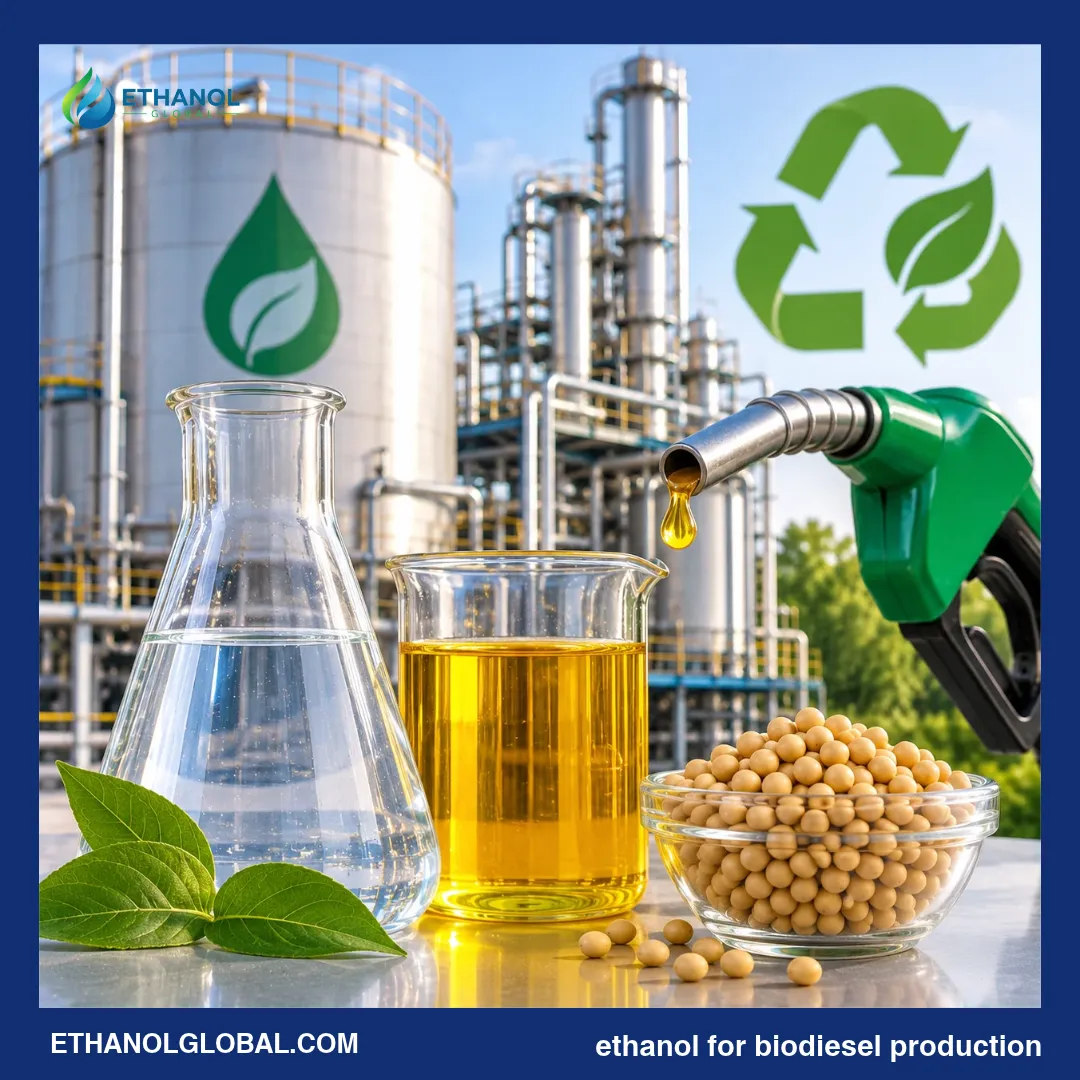
The growing demand for renewable energy has encouraged manufacturers to explore alternative methods of biodiesel production. One promising approach uses ethanol instead of methanol to convert vegetable oils and animal fats into renewable fuel.
Ethanol for biodiesel production plays an important role in this process because it reacts with triglycerides to form fatty acid ethyl esters (FAEE) and glycerol. These ethyl esters serve as the primary components of ethanol-based biodiesel.
Unlike conventional methanol-based production, ethanolysis creates ethyl esters with a different chemical structure. Furthermore, this approach can connect bioethanol production with renewable fuel manufacturing. However, manufacturers must control ethanol purity, water content, catalyst concentration, and reaction conditions to achieve efficient conversion.
1. How Ethanol-Based Biodiesel Production Works
Biodiesel production through ethanolysis relies on a chemical reaction called transesterification. During this reaction, ethanol reacts with triglycerides in vegetable oils or animal fats and produces fatty acid ethyl esters and glycerol.
The general reaction follows this equation:
Triglyceride + 3 Ethanol ⇌ 3 Fatty Acid Ethyl Esters + Glycerol
Manufacturers typically use a catalyst to accelerate this reaction and improve conversion efficiency.
Ethanol offers several potential advantages in biodiesel manufacturing:
- It can originate from renewable agricultural resources.
- It produces fatty acid ethyl esters instead of fatty acid methyl esters.
- It creates opportunities to integrate bioethanol and biodiesel production.
- It provides an alternative alcohol source for renewable fuel manufacturing.
However, ethanolysis also introduces specific processing challenges. For example, ethanol can increase the mutual solubility of biodiesel and glycerol, which makes phase separation more difficult.
2. Why Ethanol 96% Matters in Biodiesel Production
Ethanol 96% contains approximately 96% ethanol and 4% water by volume. Although this concentration offers a commercial ethanol option, its water content requires careful consideration during biodiesel manufacturing.
In addition, understanding the origin and production method of ethanol can help manufacturers evaluate its suitability for different industrial processes. Our article on [bio ethanol vs. synthetic ethanol] explains the main differences between these two production routes.
Water can interfere with alkaline transesterification in several ways. First, it can promote triglyceride hydrolysis. Additionally, the resulting free fatty acids may react with alkaline catalysts and form soap.
Soap formation creates several operational problems, including:
- Lower biodiesel recovery.
- Increased emulsion formation.
- More difficult glycerol separation.
- Higher purification requirements.
Therefore, manufacturers should evaluate ethanol moisture content before starting production. In particular, some processes may require additional ethanol dehydration to achieve better reaction performance.
The appropriate ethanol concentration ultimately depends on feedstock quality, catalyst selection, and the desired production efficiency.
3. The Transesterification Process and Reaction Conditions
Transesterification represents the most important chemical stage in ethanol-based biodiesel production. During this stage, ethanol converts triglycerides into fatty acid ethyl esters through a catalyst-assisted reaction.
Manufacturers generally consider several operating parameters to optimize this process.
Ethanol-to-Oil Ratio
The ethanol-to-oil ratio influences the reaction equilibrium. Using excess ethanol can encourage ester formation and improve triglyceride conversion. Nevertheless, excessive ethanol consumption increases recovery costs and complicates downstream separation.
Catalyst Selection
Alkaline catalysts such as sodium hydroxide and potassium hydroxide commonly support transesterification. However, feedstocks with high free fatty acid content may require acid pretreatment before alkaline processing.
This additional step helps reduce soap formation and improves subsequent processing.
Reaction Temperature
Temperature influences reaction speed and mass transfer. Manufacturers must select suitable operating temperatures while considering ethanol volatility and equipment safety.
Mixing Intensity
Effective mixing improves contact between ethanol and the oil phase. Consequently, proper agitation can support faster reactions and more consistent conversion.
Reaction Time
Reaction time determines how long the reactants interact under controlled conditions. Manufacturers should optimize this parameter to achieve the required conversion without unnecessary energy consumption.
4. Choosing Suitable Feedstocks for Ethanolysis
Feedstock quality directly influences biodiesel production efficiency. Different oils and fats contain varying amounts of triglycerides, free fatty acids, moisture, and impurities.
Manufacturers commonly consider the following materials:
Vegetable Oils: Soybean, sunflower, rapeseed, and palm oils provide triglycerides for ethyl ester production.
Animal Fats: Tallow and other processed animal fats offer alternative raw materials for biodiesel manufacturing.
Waste Cooking Oils: Recycled cooking oils can reduce raw material expenses while supporting waste valorization.
Non-Edible Oils: Certain non-food oil crops provide alternative feedstocks without directly competing with food production.
However, these materials do not have identical chemical properties. For instance, waste cooking oils often contain higher levels of free fatty acids and moisture.
Therefore, manufacturers should analyze feedstock composition before selecting the appropriate reaction conditions. Filtration, drying, and pretreatment can also improve raw material quality.
5. Fatty Acid Ethyl Ester Separation and Product Recovery
After the transesterification reaction, the mixture contains fatty acid ethyl esters, glycerol, residual ethanol, catalyst, and other impurities.
Manufacturers must separate these components to obtain purified biodiesel. The recovery process generally involves several interconnected stages.
Recent research has also explored enzymatic ethanolysis and advanced purification techniques to improve biodiesel quality. For example, a study published in Biomass and Bioenergy examines sustainable methods for removing free fatty acids from biodiesel produced through ethanolysis.
5.1 Glycerol Separation
Glycerol forms as a secondary product during transesterification. Depending on the reaction conditions, manufacturers can separate the glycerol-rich phase through settling or centrifugation.
However, residual ethanol can increase the solubility of glycerol in the ester phase. Therefore, controlling ethanol concentration before separation can improve phase disengagement.
5.2 Ethanol Recovery and Recycling
Unreacted ethanol represents a valuable recoverable material. Manufacturers can use evaporation or distillation to separate ethanol from the reaction mixture.
Afterward, appropriate purification and quality checks allow them to evaluate its suitability for reuse.
Ethanol recycling offers several economic benefits:
- It reduces fresh ethanol consumption.
- It lowers raw material expenses.
- It improves overall resource efficiency.
- It supports more sustainable production operations.
Moreover, an efficient recovery system can reduce the amount of residual alcohol in downstream processing streams.
5.3 Biodiesel Purification
The crude ester phase may contain residual glycerol, catalyst, soap, water, and unreacted materials.
Manufacturers can select different purification techniques according to their production requirements.
Common methods include:
- Water washing: Removes water-soluble contaminants.
- Dry washing: Uses suitable adsorbents to remove impurities.
- Vacuum drying: Reduces residual moisture.
- Filtration: Eliminates suspended particles.
Ultimately, an appropriate purification strategy improves product quality and prepares biodiesel for final testing.
6. Quality Control of Fatty Acid Ethyl Esters
Producing fatty acid ethyl esters does not automatically guarantee high-quality biodiesel. Manufacturers must also evaluate the final fuel through appropriate laboratory tests.
Important quality parameters include:
- Ester content.
- Kinematic viscosity.
- Density.
- Acid value.
- Water and sediment content.
- Free and total glycerol.
- Oxidation stability.
- Flash point.
Each parameter provides useful information about fuel performance and purity.
For example, excessive free glycerol can indicate incomplete separation, while high water content may negatively affect fuel storage and handling.
Furthermore, manufacturers can use international standards such as EN 14214 and ASTM D6751 as references for biodiesel quality requirements. However, they must verify the applicable specifications and testing procedures for their intended market.
7. Industrial Challenges of Ethanol-Based Biodiesel Production
Although ethanolysis offers an alternative production route, industrial manufacturers must address several technical and economic challenges.
Water Management: Water in Ethanol 96% and feedstocks can promote hydrolysis and soap formation. Therefore, moisture control plays a critical role in maintaining reaction efficiency.
Phase Separation: Ethanol can increase the mutual solubility of glycerol and fatty acid ethyl esters. Consequently, manufacturers may need additional separation and recovery operations.
Energy Consumption: Ethanol recovery requires suitable equipment and energy input. Thus, manufacturers should evaluate distillation efficiency and heat integration.
Feedstock Variability: Different feedstocks contain different levels of free fatty acids and impurities. As a result, manufacturers must adjust pretreatment and reaction conditions.
Production Costs: Ethanol consumption, catalyst requirements, purification expenses, and energy use all influence the final production cost.
Addressing these challenges can improve process stability and strengthen the economic feasibility of ethanol-based biodiesel manufacturing.
8. Improving Production Efficiency and Process Economics
Manufacturers can improve ethanol-based biodiesel production by optimizing both the chemical reaction and downstream recovery operations.
Several strategies can support this objective:
- Analyze ethanol purity and moisture content before production.
- Select feedstocks according to their chemical composition.
- Optimize ethanol-to-oil ratios and catalyst concentrations.
- Maintain suitable reaction temperatures and mixing conditions.
- Improve glycerol separation through effective process design.
- Recover and recycle unreacted ethanol.
- Select purification methods that minimize material losses.
- Monitor final fuel quality through regular laboratory testing.
Furthermore, manufacturers can integrate ethanol recovery and heat management systems into their production facilities. These improvements can reduce operating expenses and increase overall resource efficiency.
Conclusion
Ethanol-based biodiesel production provides an alternative method for converting vegetable oils, animal fats, and waste oils into renewable fuel. Through transesterification, ethanol reacts with triglycerides to produce fatty acid ethyl esters (FAEE) and glycerol.
However, successful manufacturing requires careful control of ethanol concentration, water content, feedstock quality, catalyst selection, and reaction conditions. In addition, efficient glycerol separation, ethanol recovery, and biodiesel purification play important roles in determining final product quality.
As renewable fuel markets continue to develop, ethanol-based transesterification offers opportunities for further industrial research and process optimization.
For biodiesel manufacturers, choosing a reliable ethanol supplier and verifying raw material specifications can help maintain consistent production quality. As a producer and exporter of ethanol, Ethanol Global supports industrial customers seeking reliable ethanol solutions for their manufacturing requirements.
Looking for a Reliable Ethanol Supplier for Biodiesel Production?
Choosing the right ethanol supplier plays an important role in maintaining consistent raw material quality and improving industrial production efficiency. Ethanol Global is a producer and exporter of ethanol, offering solutions for industrial customers and international markets.
If you are looking for a reliable source of Ethanol 96% for biodiesel production or other industrial applications, contact our team to discuss your requirements.
Contact Ethanol Global today to request a price quotation, product specifications, or an analysis certificate.