
Introduction
Ethyl lactate is an important bio-based solvent used in coatings, cleaning products, pharmaceuticals, cosmetics, and specialty chemical manufacturing. Its biodegradability, relatively low toxicity, and effective solvent properties make it an attractive alternative to several conventional petroleum-derived solvents.
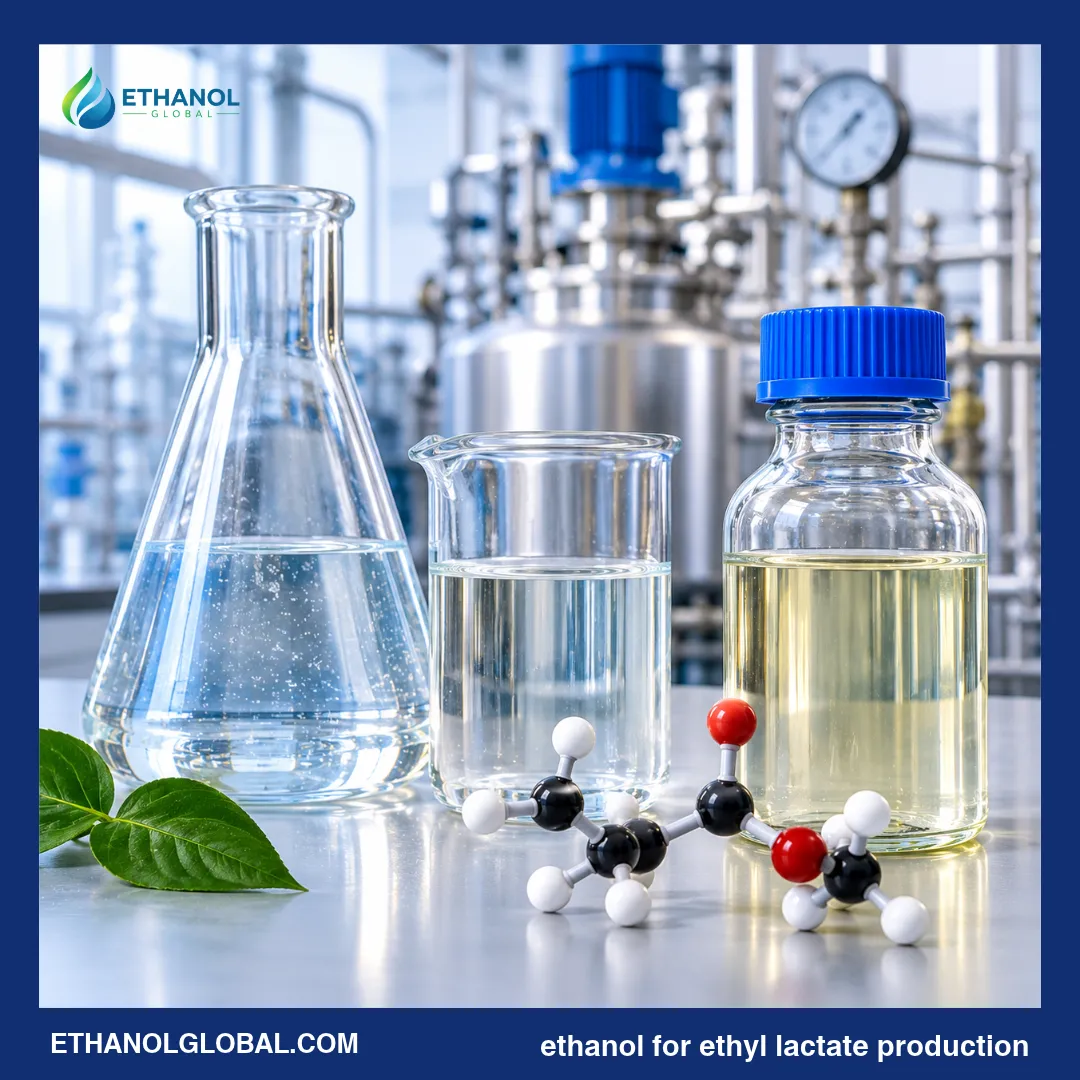
One of the main raw materials required for its manufacture is ethanol. In particular, ethanol for ethyl lactate production plays a central role in the esterification reaction, where ethanol reacts with lactic acid to form ethyl lactate and water.
However, industrial production requires more than simply combining these two materials. Reaction equilibrium, feedstock purity, water removal, catalyst selection, and downstream purification all influence the final product quality.
This article examines the main production routes, the role of Ethanol 96%, water management strategies, and purification considerations in industrial ethyl lactate manufacturing.
1. Understanding the Chemistry of Ethyl Lactate Production
Ethyl lactate is an ester formed through the reaction between ethanol and lactic acid. This reaction is commonly classified as Fischer esterification.
The overall chemical reaction is:
Lactic Acid + Ethanol ⇌ Ethyl Lactate + Water
The reaction can be represented by the following chemical equation:
CH₃CH(OH)COOH + C₂H₅OH ⇌ CH₃CH(OH)COOC₂H₅ + H₂O
In this process, ethanol provides the ethyl group required for ester formation, while lactic acid supplies the lactate structure.
Because the reaction is reversible, the presence of water can limit the achievable conversion. Therefore, industrial manufacturers must carefully control the reaction environment to obtain higher yields.
Acid catalysts are commonly used to accelerate esterification. Depending on the process design, manufacturers may select homogeneous acid catalysts or solid acid catalysts, such as sulfonated ion-exchange resins.
2. The Role of Ethanol 96% in Ethyl Lactate Manufacturing
Ethanol 96% is a commercially available industrial feedstock that can be considered for ethyl lactate manufacturing. Its relatively high ethanol concentration makes it useful in processes where ethanol availability, cost, and supply reliability are important.
However, its water content requires careful consideration.
Unlike anhydrous ethanol, Ethanol 96% contains a measurable amount of water. The exact concentration depends on the specification and whether the stated purity is based on volume or weight.
This distinction is important because water directly affects esterification equilibrium.
2.1. Feedstock Purity and Reaction Performance
The purity of ethanol influences the overall reaction environment. Higher water concentrations can reduce the driving force for ester formation.
Consequently, manufacturers should evaluate the following parameters before selecting ethanol as a feedstock:
- Ethanol concentration and measurement basis
- Water content and moisture specification
- Acidity and potential contaminants
- Batch-to-batch consistency
- Compatibility with the selected catalyst
- Availability of suitable dehydration equipment
Although Ethanol 96% can be used in esterification processes, additional dehydration may improve reaction performance, particularly in processes that rely on simultaneous water removal.
2.2. Why Ethanol Quality Matters
Consistent ethanol quality supports more predictable reaction conditions and simplifies process control.
Furthermore, impurities can affect catalyst performance, separation efficiency, and final product specifications.
For this reason, industrial buyers should evaluate the Certificate of Analysis (COA) and technical specifications before purchasing ethanol for ethyl lactate production.
3. Main Esterification Routes for Ethyl Lactate Production
Several process configurations can be used to manufacture ethyl lactate. The most important approaches involve conventional esterification, distillation-enhanced esterification, and integrated reaction-separation systems.
3.1. Conventional Batch Esterification
Batch esterification is one of the straightforward approaches to ethyl lactate manufacturing.
In this method, ethanol and lactic acid are introduced into a reactor. An acid catalyst is then added to promote the reaction.
The process generally involves:
- Preparing and checking the ethanol and lactic acid feedstocks.
- Charging the reactor with the required reactants.
- Introducing the selected catalyst.
- Maintaining controlled reaction temperature and mixing.
- Monitoring conversion and reaction progress.
- Transferring the reaction mixture to downstream purification.
One limitation of conventional batch esterification is the accumulation of water during the reaction. A similar esterification approach is used in the production of ethyl acetate from ethanol 96%, where reaction pathways, catalyst selection, and water management also influence process efficiency. For further details, see our guide on Ethyl Acetate Production from Ethanol 96%.
As water concentration increases, the reaction approaches equilibrium, which can restrict additional ethyl lactate formation.
Therefore, excess ethanol or an appropriate water-removal strategy may be necessary to improve conversion.
3.2. Distillation-Enhanced Esterification
Distillation-enhanced esterification combines chemical reaction with the separation of volatile components.
During this process, ethanol can help remove water from the reaction environment through controlled vaporization and condensation.
This approach offers several advantages:
- Improved control of water concentration
- Potentially higher lactic acid conversion
- Opportunities for ethanol recovery and reuse
- Better integration of reaction and separation operations
However, the effectiveness of this method depends strongly on feedstock composition.
Research published in 2021 demonstrated that dehydrated ethanol could provide better performance than Ethanol 96% when used as a stripping agent in reactive distillation experiments.
Therefore, feedstock dehydration should be considered when designing an efficient industrial process.
3.3. Reactive Distillation
Reactive distillation integrates reaction and separation within a single process system.
Instead of performing esterification and distillation as completely separate operations, the equipment allows chemical conversion and selected component separation to occur simultaneously.
This approach can reduce the number of separate processing steps and improve process integration.
Nevertheless, ethyl lactate production presents specific separation challenges because ethanol, water, lactic acid, and ethyl lactate have different volatility characteristics.
As a result, column configuration, feed composition, heat input, and operating conditions require careful optimization.
Reactive distillation is particularly attractive for continuous manufacturing operations where process intensification and energy efficiency are important.
4. Water Management in Ethyl Lactate Production
Water management is one of the most important factors in ethyl lactate manufacturing.
Since esterification produces water as a reaction by-product, its accumulation shifts the equilibrium toward the reactants. Research published in Open Research Europe also highlights the importance of water removal and feedstock preparation in ethyl lactate manufacturing. The study, Ethyl Lactate Production by Reactive Distillation, examines reaction kinetics, process configurations, and energy efficiency in esterification systems.
Consequently, removing water can improve ethyl lactate formation and increase lactic acid conversion.
Several approaches are available for industrial water management.
4.1. Ethanol Dehydration Before Reaction
One approach is to reduce the water content of ethanol before introducing it into the reactor.
Molecular sieve adsorption is a well-established industrial dehydration technique. It selectively adsorbs water and produces ethanol with a higher concentration.
Membrane-based dehydration technologies, including pervaporation, can also be considered.
Although Ethanol 96% is suitable for various industrial applications, dehydration may be beneficial when the process requires very low initial water content.
4.2. Water Removal During Esterification
Another strategy involves removing water while the reaction is taking place.
This can be achieved through:
- Reactive distillation
- Controlled evaporation and condensation
- Membrane-assisted separation
- Integrated reaction and separation systems
These methods help reduce water accumulation and can improve the overall reaction equilibrium.
For example, esterification combined with pervaporation has demonstrated the ability to increase ethyl lactate production by selectively removing water from the reaction mixture.
4.3. Selecting the Appropriate Water Management Strategy
The most suitable method depends on the initial water concentration, production capacity, energy consumption, equipment investment, and desired product specifications.
For smaller production facilities, a conventional reactor followed by suitable separation equipment may offer operational simplicity.
In contrast, larger continuous facilities may benefit from integrated reaction and separation technologies.
Therefore, process selection should consider the entire production system rather than focusing exclusively on the esterification reactor.
5. Industrial Purification of Ethyl Lactate
After esterification, the resulting mixture contains ethyl lactate along with residual ethanol, water, unreacted lactic acid, catalyst residues, and potentially other impurities.
The purpose of downstream purification is to remove these components and achieve the required commercial product specifications.
5.1. Removal and Recovery of Residual Ethanol
Residual ethanol can be separated from the reaction mixture using appropriate distillation operations.
Recovered ethanol may be evaluated for reuse after suitable purification and quality testing.
This approach can reduce raw material consumption and improve the economic efficiency of the manufacturing process.
However, the recycling stream must meet the required feedstock specifications before returning to the production system.
5.2. Water Separation
Water must be controlled throughout the purification process.
Depending on the process configuration, distillation, membrane separation, or other suitable separation technologies may be used.
Efficient water separation is particularly important because residual moisture can affect product specifications and storage stability.
5.3. Removal of Residual Lactic Acid and Catalyst
Unreacted lactic acid and catalyst residues can influence the acidity and purity of the final product.
Solid acid catalysts may simplify separation because they can be retained or removed from the liquid phase.
When homogeneous catalysts are used, additional purification or neutralization operations may be required.
The selected treatment must also prevent unwanted contamination of the final ethyl lactate.
5.4. Final Distillation and Product Finishing
Final distillation is commonly considered for achieving the required ethyl lactate purity.
Vacuum distillation may be advantageous when lower operating temperatures are needed to reduce thermal exposure.
The appropriate purification conditions depend on feed composition, equipment design, and the desired commercial grade.
Manufacturers should avoid assuming that one distillation configuration is suitable for every production system.
6. Quality Control in Ethyl Lactate Manufacturing
Consistent product quality is essential for manufacturers supplying pharmaceutical, cosmetic, coating, and industrial solvent markets.
Quality control should cover both raw materials and the finished product.
Important parameters include:
| Quality Parameter | Industrial Importance |
|---|---|
| Ethyl lactate purity | Determines product suitability |
| Water content | Influences moisture specifications |
| Residual ethanol | Indicates separation efficiency |
| Acidity | Helps assess residual acidic components |
| Color and appearance | Supports product consistency |
| Residual impurities | Determines suitability for specific applications |
Analytical methods such as gas chromatography, Karl Fischer titration, and acid value testing can be selected according to the required specifications.
In addition, incoming ethanol should be tested for purity and moisture before being introduced into the production process.
A documented quality management system helps manufacturers maintain consistency between production batches.
7. Economic and Operational Considerations
The economics of ethyl lactate production depend on several interconnected factors.
Ethanol consumption, lactic acid pricing, catalyst selection, energy requirements, and purification efficiency all influence production costs.
However, feedstock price alone does not determine the most economical production route.
For example, using lower-cost Ethanol 96% may appear attractive. Nevertheless, additional dehydration or separation requirements could affect total operating expenses.
Industrial manufacturers should evaluate:
- Ethanol purchasing costs and supply reliability
- Lactic acid availability and concentration
- Catalyst lifetime and replacement costs
- Energy consumption during reaction and distillation
- Ethanol recovery and recycling efficiency
- Wastewater treatment requirements
- Final product purity and market specifications
A complete material and energy balance is essential for comparing alternative production configurations.
Furthermore, integrating ethanol recovery with water separation can help improve resource efficiency and reduce unnecessary material losses.
8. Industrial Applications of Ethyl Lactate
The demand for ethyl lactate is associated with its solvent properties and potential to replace selected conventional organic solvents.
Its applications include:
Paints and Coatings: Ethyl lactate can be used as a solvent in selected coating formulations, helping dissolve or disperse different formulation components.
Cleaning Products: Its solvent characteristics make it useful in certain industrial cleaning formulations.
Pharmaceutical Manufacturing: Ethyl lactate can serve as a process solvent in selected pharmaceutical applications, subject to the relevant purity and regulatory requirements.
Cosmetics: It is used in selected cosmetic and personal care formulations.
Printing Inks: Its solvent properties support applications in certain printing ink formulations.
As industries increasingly evaluate alternative solvents, reliable access to suitable raw materials becomes an important consideration for ethyl lactate manufacturers.
9. Conclusion
Ethyl lactate manufacturing depends on the efficient esterification of lactic acid with ethanol, followed by appropriate separation and purification operations.
Ethanol 96% can serve as a feedstock for this process. However, its water content must be considered when selecting the reaction configuration and water management strategy.
Conventional esterification, distillation-enhanced processes, and reactive distillation each offer different operational advantages.
Moreover, effective ethanol recovery, water removal, catalyst management, and final purification are essential for achieving consistent product quality.
For manufacturers, selecting the right ethanol specification is therefore an important part of optimizing the entire production process.
Reliable sourcing of industrial ethanol, supported by consistent quality specifications and technical documentation, can help improve feedstock management and manufacturing reliability.
Contact Us for Industrial Ethanol 96% Supply
Are you looking for a reliable supplier of high-quality Ethanol 96% for ethyl lactate production and other industrial applications?
Ethanol Global is a producer and exporter of industrial ethanol, offering reliable supply solutions for manufacturers and international buyers.
Contact our sales team to discuss your requirements, request product specifications, and receive a competitive price quotation.
- Product: Industrial Ethanol 96%
- Applications: Ethyl lactate production and industrial chemical manufacturing
- Documentation: Technical Data Sheet (TDS) and Certificate of Analysis (COA)
Contact Ethanol Global today to request a quotation and discuss your industrial ethanol supply requirements.