Introduction
Ethyl acetate is an important organic solvent used in paints, coatings, adhesives, printing inks, and pharmaceutical manufacturing. Its useful solvent properties and broad industrial applications make it a valuable chemical for manufacturers and distributors worldwide.
Ethyl acetate production can involve several chemical pathways, including the esterification of ethanol with acetic acid and the catalytic conversion of ethanol through dehydrogenation and subsequent reactions. The selection of a production route depends on raw material availability, catalyst performance, energy consumption, product purity, and overall operating costs.
Ethanol 96% can serve as a feedstock for selected production processes. However, its water content must be considered when choosing the reaction route and designing the separation system. Understanding these factors helps chemical manufacturers evaluate process efficiency and production economics.
1. The Role of Ethanol 96% in Ethyl Acetate Production
Ethanol 96% typically contains approximately 96% ethanol and 4% water by volume, although the exact specification depends on the supplier and product standard. This composition affects its suitability for different chemical processes.
Understanding how ethanol is manufactured and purified is essential for evaluating its suitability as a chemical feedstock. Learn more about the ethanol production process and the factors that influence Ethanol 96% quality.
In conventional esterification, ethanol reacts with acetic acid to produce ethyl acetate and water. Because water is already present in the ethanol feedstock, the process must account for the additional moisture when determining equilibrium conditions and separation requirements.
Before selecting ethanol 96% for industrial production, manufacturers should evaluate several factors:
- Ethanol concentration: Confirm the feedstock specification and analytical certificate.
- Water content: Determine whether the existing moisture level is acceptable for the selected process.
- Impurities: Check for substances that could affect catalyst activity or final product quality.
- Supply consistency: Maintain reliable feedstock quality to support stable production.
- Feedstock cost: Compare the purchase price with the additional processing costs required.
Consequently, ethanol 96% may offer practical advantages where its price and availability are favorable, but the economic benefit depends on the complete process rather than the feedstock price alone.
2. Main Reaction Pathways for Ethyl Acetate Production
Industrial manufacturers can consider several production pathways. Each route has different requirements for raw materials, catalysts, reactors, and downstream purification.
2.1. Fischer Esterification
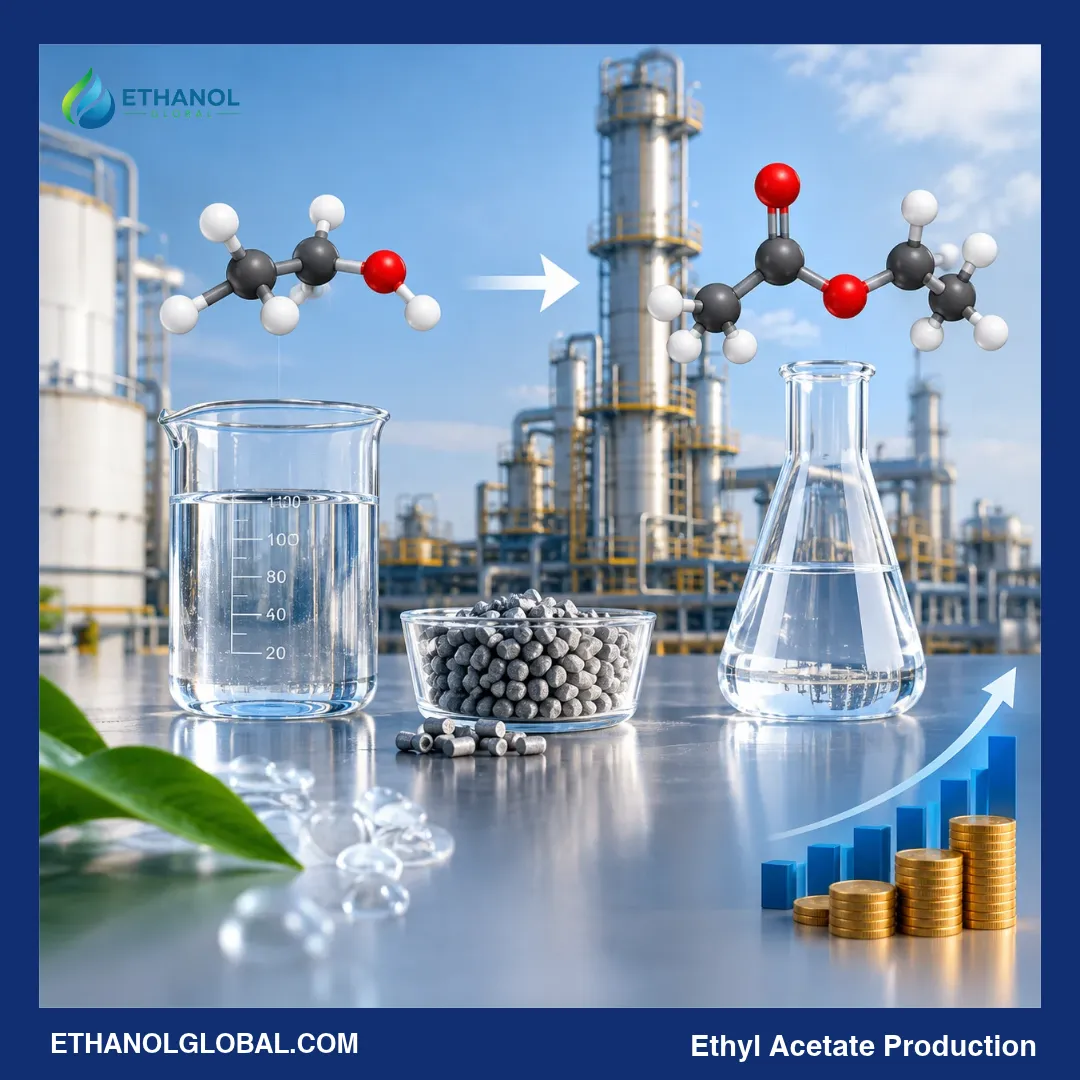
Fischer esterification is a widely used method for producing ethyl acetate. It involves the reaction between ethanol and acetic acid in the presence of an acid catalyst.
The overall reaction is:
C₂H₅OH + CH₃COOH ⇌ CH₃COOC₂H₅ + H₂O
In this reaction, ethanol reacts with acetic acid to form ethyl acetate and water. Since the reaction is reversible, the final conversion depends on the operating conditions, reactant proportions, catalyst, and management of the water formed during the reaction.
Sulfuric acid is one possible catalyst, while solid acid catalysts may offer alternative process configurations. The choice depends on corrosion management, catalyst recovery, equipment requirements, and product specifications.
When ethanol 96% is used, its initial water content becomes an important design consideration. Additional water can influence equilibrium and increase the burden on downstream separation. Therefore, manufacturers should evaluate the feedstock composition before determining the required reactor and purification design.
2.2. Ethanol Dehydrogenation and Condensation
An alternative pathway converts ethanol into ethyl acetate through catalytic dehydrogenation and subsequent reactions.
The overall reaction can be represented as:
2C₂H₅OH ⇌ CH₃COOC₂H₅ + 2H₂
In this process, ethanol is first converted into acetaldehyde and hydrogen. Subsequent reactions form ethyl acetate, with hydrogen produced as a coproduct.
The pathway can be attractive when hydrogen recovery, catalyst performance, and integrated process design provide economic advantages. However, the process requires careful control of reaction conditions and management of by-products.
Water in the ethanol 96% feedstock must also be considered when assessing catalyst behavior and process performance. The suitability of this feedstock depends on the specific technology and its operating requirements.
2.3. Selecting the Appropriate Production Route
The best pathway depends on the manufacturer’s operating conditions and commercial objectives.
| Evaluation Factor | Fischer Esterification | Ethanol Dehydrogenation |
|---|---|---|
| Main feedstock | Ethanol and acetic acid | Ethanol |
| Main reaction approach | Acid-catalyzed esterification | Catalytic conversion and condensation |
| Main coproduct | Water | Hydrogen |
| Key process challenge | Reaction equilibrium and separation | Catalyst selectivity and reaction control |
| Important economic factor | Raw materials and purification energy | Catalyst performance, energy, and hydrogen recovery |
These are general process distinctions rather than a universal ranking. Actual performance depends on the technology, feedstock specifications, plant configuration, and local utility costs.
3. Catalyst Selection and Process Performance
Catalysts influence reaction rates, selectivity, operating requirements, and the formation of unwanted products. Their selection is therefore a central part of ethyl acetate production.
For Fischer esterification, manufacturers may evaluate sulfuric acid and solid acid catalysts. Sulfuric acid can provide effective catalytic activity, but its use requires attention to corrosion, acid handling, neutralization where applicable, and waste management.
Solid acid catalysts may simplify certain separation or recovery operations. However, their performance depends on factors such as catalyst composition, operating temperature, water tolerance, and resistance to deactivation.
For ethanol dehydrogenation, catalyst selection must support ethanol conversion and favorable selectivity toward ethyl acetate. Catalyst stability and the management of competing reactions are particularly important when evaluating continuous operation.
Manufacturers should compare catalysts using measurable performance indicators:
- Ethanol conversion.
- Ethyl acetate selectivity and yield.
- Catalyst lifetime and replacement frequency.
- Energy consumption per unit of product.
- Separation requirements and product purity.
- Waste generation and maintenance costs.
A catalyst with a lower purchase price does not necessarily deliver the lowest production cost. Its lifetime, performance, and impact on downstream processing must also be considered.
4. Process Design and Product Purification
After the reaction stage, the process stream may contain ethyl acetate, unreacted feedstock, water, and other compounds. The separation system must recover the desired product while controlling losses and meeting the required quality specification.
For a deeper understanding of production costs, energy requirements, and alternative synthesis routes, see this research on the techno-economic assessment of ethyl acetate production.
In conventional esterification plants, distillation and associated separation equipment play a major role in product recovery. Water management is especially important because ethanol, water, and ethyl acetate have complex vapor-liquid equilibrium behavior.
Reactive distillation provides another process design option by combining reaction and separation in an integrated unit. Process integration can reduce energy requirements and equipment costs in suitable configurations, although the results depend on the selected design and operating assumptions.
A well-designed purification system should address:
- Recovery of ethyl acetate from the reaction mixture.
- Separation and possible recycling of unreacted feedstock.
- Removal of water and other impurities.
- Control of product losses during distillation.
- Verification of the final product against customer specifications.
The target purity should be established before equipment selection. Producing a higher-purity product may increase energy consumption, equipment requirements, and operating costs.
5. Process Economics: What Determines Production Cost?
The economics of ethyl acetate production depend on more than the price of ethanol 96%. A reliable assessment should include feedstock consumption, catalyst costs, utilities, equipment, labor, maintenance, product recovery, and waste treatment.
5.1. Raw Material Costs
Ethanol and acetic acid prices can significantly affect the economics of the esterification route. For ethanol-based dehydrogenation, ethanol consumption and the value of recoverable hydrogen are important considerations.
When evaluating ethanol 96%, manufacturers should compare its delivered cost with the total cost of any additional treatment needed to achieve the required feed specification.
5.2. Energy Consumption
Heating reactors, operating distillation columns, cooling process streams, and recycling unreacted materials can contribute substantially to operating expenses.
Process integration, heat recovery, and optimized separation may reduce utility consumption. However, the actual savings must be established through process simulation or plant data rather than assumed in advance.
5.3. Catalyst and Maintenance Expenses
Catalyst replacement, reactor cleaning, corrosion control, and equipment maintenance all affect production economics. A process with high conversion but frequent shutdowns may be less profitable than a slightly less intensive process with more stable operation.
5.4. Product Yield and Recovery
Yield and recovery are related but distinct measures. Yield describes how effectively the feedstock is converted into the desired product, while recovery measures how much of the product is successfully isolated from the process stream.
Both metrics influence the quantity of saleable ethyl acetate obtained from a given amount of raw material.
5.5. Capital and Operating Costs
Capital expenditure (CAPEX) includes the investment required for reactors, separation columns, storage tanks, utilities, and safety systems. Operating expenditure (OPEX) includes recurring costs such as raw materials, energy, labor, maintenance, and waste treatment.
A meaningful comparison between production routes should consider both cost categories over the expected operating life of the facility.
6. How to Evaluate Production Profitability
Manufacturers can use a structured economic assessment to compare alternative process configurations.
First, establish the required annual production capacity and product purity. Next, estimate the consumption of ethanol, acetic acid where applicable, catalysts, and utilities. Then, calculate expected product recovery and the costs associated with waste handling and maintenance.
A simplified production-cost equation is:
Unit Production Cost = Annual Operating Costs ÷ Annual Saleable Output + Annualized Capital Cost per Unit
The calculation should use consistent units and clearly defined accounting assumptions. It should also distinguish production cost from selling price and profit margin.
A sensitivity analysis can reveal how changes in ethanol prices, electricity tariffs, catalyst lifetime, and product selling prices affect profitability. This is particularly valuable for export-oriented producers operating in markets with fluctuating input and transportation costs.
7. Quality Control and Industrial Safety
Product quality begins with consistent feedstock specifications and continues through reaction, separation, storage, and shipment.
Manufacturers should monitor ethanol concentration, feedstock impurities, reaction performance, and final ethyl acetate specifications. Depending on the intended application, quality testing may include purity, water content, acidity, and other relevant parameters.
Safety also requires careful attention. Ethanol and ethyl acetate are flammable, and certain catalysts introduce additional chemical hazards. Industrial facilities should provide appropriate ventilation, ignition-source control, compatible equipment, suitable protective equipment, and procedures for handling spills and waste.
For export operations, accurate labeling, suitable packaging, and compliance with applicable transport regulations are essential. Quality documentation and consistent batch records can also help buyers evaluate product suitability.
8. Practical Considerations for Ethanol 96% Buyers
For manufacturers considering ethanol 96% as a feedstock, purchasing decisions should account for both technical suitability and supply-chain reliability.
Before placing an order, buyers should review:
- Feedstock concentration and certificate of analysis.
- Water content and impurity limits.
- Available packaging and bulk-delivery options.
- Consistency between batches.
- Delivery lead times and export documentation.
- Total delivered cost rather than the quoted price alone.
A supplier that provides consistent specifications and dependable deliveries can help manufacturers reduce feedstock variability and improve production planning.
The final decision should reflect the requirements of the selected process. Ethanol 96% may be suitable for some production configurations, while others may require a different feed specification or additional treatment.
Conclusion
Ethyl acetate production from ethanol 96% requires a careful evaluation of reaction chemistry, catalyst performance, water management, purification, and process economics. Fischer esterification offers an established route using ethanol and acetic acid, while ethanol dehydrogenation provides an alternative pathway with hydrogen as a coproduct.
Neither route is automatically the most economical under all conditions. Manufacturers should compare raw material prices, catalyst lifetime, energy requirements, product recovery, and capital investment before selecting a process.
Reliable feedstock quality is an important part of this decision. By combining suitable ethanol specifications with efficient process design and effective quality control, producers can make better-informed decisions about operational performance and long-term production costs.
Request a Quote for Ethanol 96%
Looking for a reliable supplier of Ethanol 96% for industrial applications? Contact Ethanol Global to request a competitive quotation, obtain product specifications, and discuss your bulk supply requirements.